
Question 421 markMCQAsked 2025Easy
The metal whose oxide can be reduced by common reducing agents:
Confirming your payment
Sign up now and get 250 free tokens.
Previous Year Questions · Question 42 of 57
The metal whose oxide can be reduced by common reducing agents:
(A) Copper
(B) Sodium
(C) Aluminium
(D) Potassium
Answer: (A) Copper
Concept: The method used to get a metal from its oxide depends on its place in the activity series: K, Na, Ca, Mg, Al, Zn, Fe, Pb, [H], Cu, Hg, Ag, Au (most reactive first). Oxides of K to Al are too stable for chemical reducing agents, so these metals are obtained by electrolysis of their fused compounds; oxides of Zn to Cu are reduced by carbon, carbon monoxide or hydrogen (zinc oxide by carbon only).
Step 1 — Place each metal.
Potassium, sodium and aluminium are at the top of the activity series; copper is below hydrogen.
Step 2 — Reduce the oxide.
Copper(II) oxide gives up its oxygen easily, so hydrogen (or carbon, or carbon monoxide) reduces it on heating.
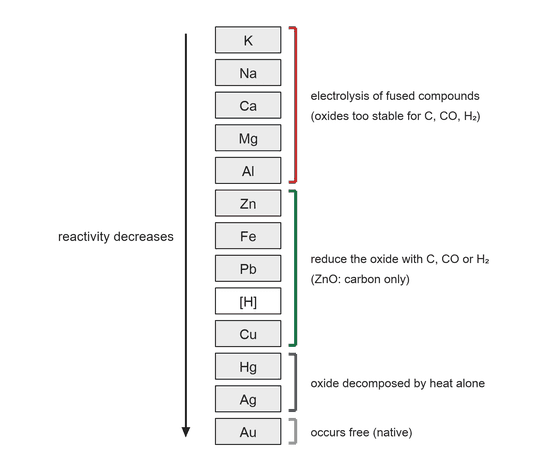
Watch out: A LOW place in the activity series means the oxide is EASY to reduce.
Why the other options are wrong:
Therefore, the metal whose oxide is reduced by common reducing agents is copper, option (A).