
Question 431 markMCQAsked 2025Easy
The ore that can be concentrated by using magnetic separation:
Confirming your payment
Sign up now and get 250 free tokens.
Previous Year Questions · Question 43 of 57
The ore that can be concentrated by using magnetic separation:
(A) Corundum
(B) Haematite
(C) Calamine
(D) Bauxite
Answer: (B) Haematite
Concept: Magnetic separation is used when the ore and the gangue differ in magnetic properties. The crushed ore falls on a belt running over a magnetic roller: the particles attracted by the magnet cling to the belt and drop close to the roller, while the non-magnetic gangue is thrown farther away.
Step 1 — Find the iron ore.
Corundum (Al₂O₃) and bauxite (Al₂O₃·2H₂O) are ores of aluminium, and calamine (ZnCO₃) is an ore of zinc. Haematite (Fe₂O₃) is the only ore of iron among the options.
Step 2 — Apply magnetic separation.
Iron ores are attracted by a strong magnet while the gangue is not, so haematite drops close to the magnetic roller and the gangue is thrown farther away. (Haematite is weakly magnetic, so a strong magnet is used; magnetite, Fe₃O₄, is strongly magnetic.)
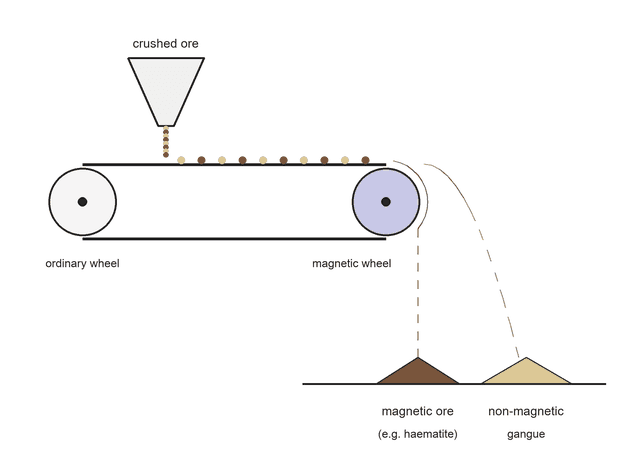
Watch out: Magnetic separation needs an ore that a magnet attracts; aluminium and zinc ores are not attracted.
Why the other options are wrong:
Therefore, the ore concentrated by magnetic separation is haematite, option (B).