(ii) An alloy of lead and tin that is used in electrical circuits.
(iii) An ore of zinc containing its sulphide.
(iv) A metal oxide that can be reduced by hydrogen.
Solution:
Concept: Each answer is a term or a substance of this chapter: protecting iron from rusting, alloys, ores and the reduction of metal oxides.
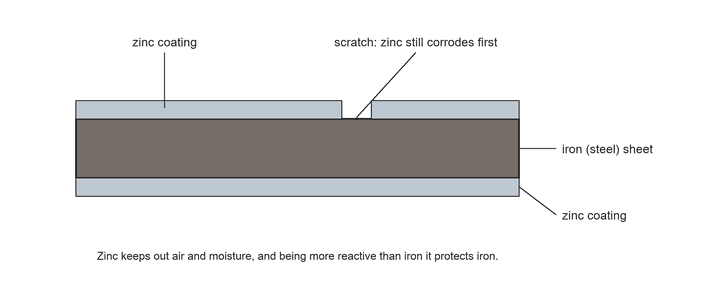
(i) Coating iron with zinc
Step 1 — Name the process.
Coating iron with a layer of zinc is called galvanisation. The zinc keeps air and moisture away from the iron. Zinc is more reactive than iron, so even where the coating is scratched the zinc corrodes first and the iron is protected.
(ii) Lead–tin alloy used in electrical circuits
Step 2 — Name the alloy.
The alloy is solder (also called fuse metal), lead 50% and tin 50%. It starts to melt at about 183 °C, lower than lead or tin alone, so it is easy to melt for joining wires in circuits.
(iii) Sulphide ore of zinc
Step 3 — Name the ore.
The sulphide ore of zinc is zinc blende, ZnS.
(iv) Metal oxide reduced by hydrogen
Step 4 — Name an oxide and show the reduction.
Copper is below hydrogen in the activity series, so hot copper(II) oxide, CuO, gives up its oxygen to hydrogen. (Oxides of lead and iron are also reduced by hydrogen.)
CuO+H2ΔCu+H2O
Watch out: Galvanisation uses ZINC; tinning (coating with tin) is a different process.