
Question 361 markMCQAsked 2024Easy
The compound that is not a constituent of the electrolytic mixture used in the Hall-Heroult's process is:
Confirming your payment
Sign up now and get 250 free tokens.
Previous Year Questions · Question 36 of 57
The compound that is not a constituent of the electrolytic mixture used in the Hall-Heroult's process is:
(A)
(B)
(C)
(D)
Answer: (B)
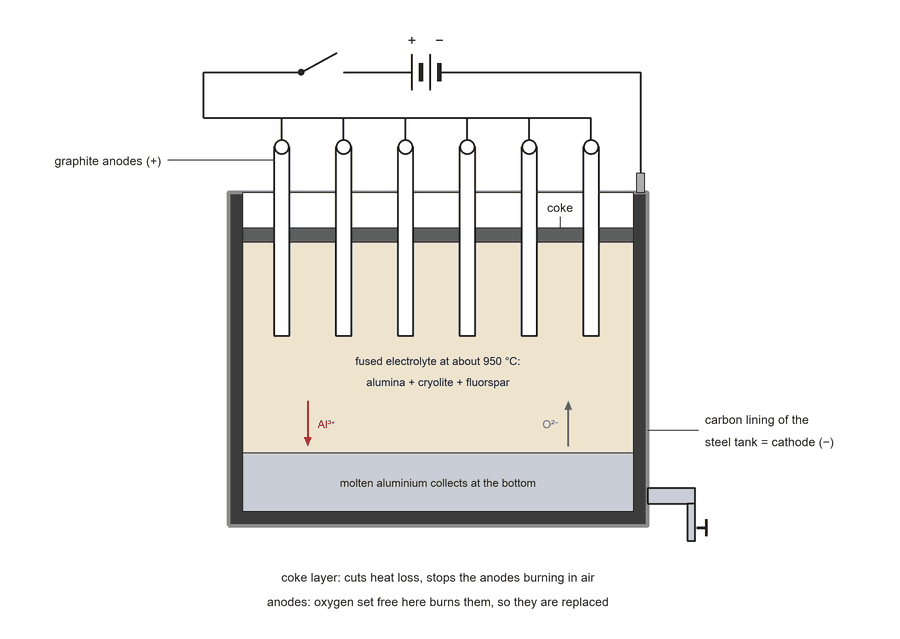
Concept: In the Hall–Héroult cell the electrolyte is a fused mixture of alumina (about 20%), cryolite, Na₃AlF₆ (about 60%) and fluorspar, CaF₂ (about 20%), kept at about 950 °C. Thick graphite rods dipping into it are the anodes (+), and the carbon lining of the steel tank is the cathode (−).
Step 1 — List the electrolyte.
The electrolytic mixture is Al₂O₃, Na₃AlF₆ and CaF₂, so options (A), (C) and (D) are all constituents.
Step 2 — Place sodium aluminate.
Sodium (meta) aluminate, NaAlO₂, is formed earlier, in Bayer's process, when bauxite dissolves in caustic soda. It is then turned into aluminium hydroxide and alumina, so it is never put into the electrolytic cell.
Watch out: NaAlO₂ and Na₃AlF₆ both contain sodium and aluminium; only cryolite (Na₃AlF₆) is in the cell.
Why the other options are wrong:
Therefore, the compound that is not a constituent of the electrolytic mixture is NaAlO₂, option (B).