
Question 502 marksAsked 2025Easy
Answer the following questions related to the electrolytic reduction of pure Alumina by Hall Heroult’s process.
(a) The reaction occurring at the anode.
(b) The reaction occurring at the cathode.
Confirming your payment
Sign up now and get 250 free tokens.
Previous Year Questions · Question 50 of 57
Answer the following questions related to the electrolytic reduction of pure Alumina by Hall Heroult’s process.
(a) The reaction occurring at the anode.
(b) The reaction occurring at the cathode.
Solution:
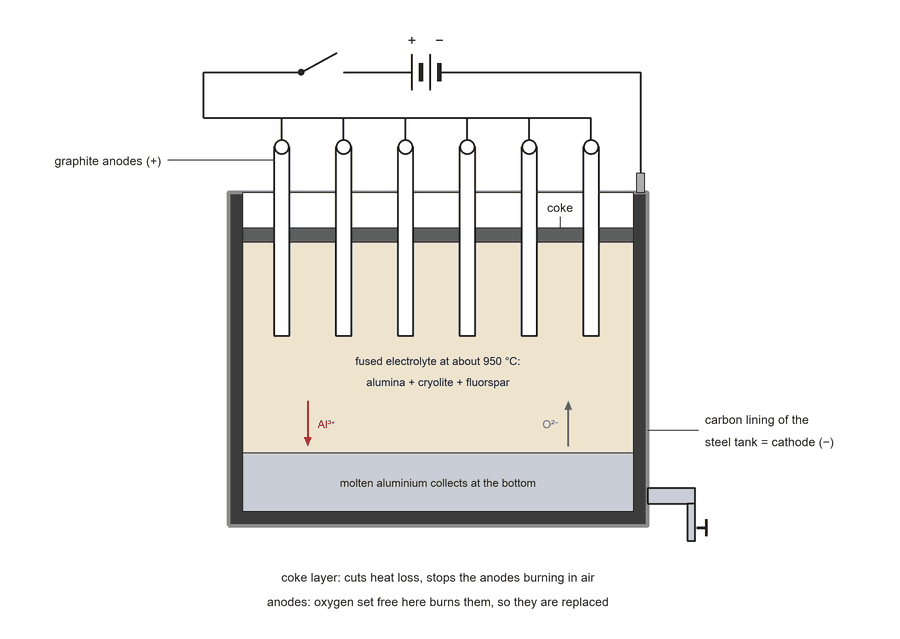
Concept: Fused alumina gives aluminium ions and oxide ions. Oxide ions are oxidised (lose electrons) at the graphite anode; aluminium ions are reduced (gain electrons) at the cathode, the carbon lining.
Step 1 — Write the ions present.
In the molten electrolyte the alumina is split into ions.
(a) Reaction at the anode
Step 2 — Oxidation of oxide ions.
The oxide ions move to the anode and lose electrons, forming oxygen atoms, which join to form oxygen gas.
The oxygen then burns the hot graphite anode, which is why the anodes are replaced from time to time.
(b) Reaction at the cathode
Step 3 — Reduction of aluminium ions.
The aluminium ions move to the cathode and each gains three electrons.
Watch out: The electrons lost at the anode (12) equal the electrons gained at the cathode (12).
Therefore, (a) at the anode: 6O²⁻ − 12e⁻ → 6[O], then 6[O] → 3O₂; (b) at the cathode: 4Al³⁺ + 12e⁻ → 4Al.