
Question 541 markMCQAsked 2026Easy
The process of dressing (purification) of the ore which involves separation of ore from gangue due to preferential wetting is:
Confirming your payment
Sign up now and get 250 free tokens.
Previous Year Questions · Question 54 of 57
The process of dressing (purification) of the ore which involves separation of ore from gangue due to preferential wetting is:
(A) Magnetic Separation
(B) Hydrolytic method
(C) Froth flotation method
(D) Chemical method
Answer: (C) Froth flotation method
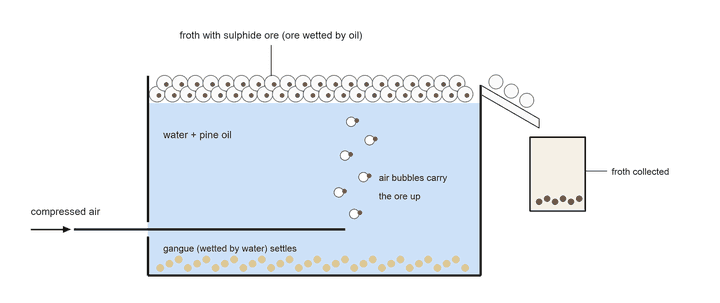
Concept: Froth floatation concentrates sulphide ores. It works on preferential wetting: the ore particles are wetted by oil (pine oil) and the gangue particles are wetted by water.
Step 1 — Read the clue.
The question describes separation by preferential wetting, which is exactly the principle of froth floatation.
Step 2 — See how it works.
The ore particles, wetted by pine oil, stick to air bubbles and rise into the froth; the gangue, wetted by water, sinks. Sulphide ores such as zinc blende and galena are concentrated this way.
Watch out: Froth floatation works on wetting, not on density.
Why the other options are wrong:
Therefore, the process based on preferential wetting is the froth flotation method, option (C).