Solution:
Concept: In the Hall–Héroult cell the electrolyte is a fused mixture of alumina (about 20%), cryolite, Na₃AlF₆ (about 60%) and fluorspar, CaF₂ (about 20%), kept at about 950 °C. Thick graphite rods dipping into it are the anodes (+), and the carbon lining of the steel tank is the cathode (−).
(i) Function of cryolite
Step 1 — Explain the role of cryolite.
Cryolite dissolves the alumina and lowers the fusion temperature of the electrolyte from about 2050 °C to about 950 °C, saving energy. It also increases the electrical conductivity, because pure alumina is a very poor conductor.
(ii) Why powdered coke is sprinkled on top
Step 2 — Explain the coke layer.
The coke layer reduces the loss of heat by radiation from the surface of the bath, and it prevents the hot graphite anodes from burning in the air.
(iii) Electrode from which aluminium is collected
Step 3 — Find the electrode.
Aluminium ions are positive, so they move to the cathode (the carbon lining of the steel tank) and gain electrons there.
4Al3++12e−→4Al
The molten aluminium collects at the bottom of the tank, on the cathode, and is tapped off.
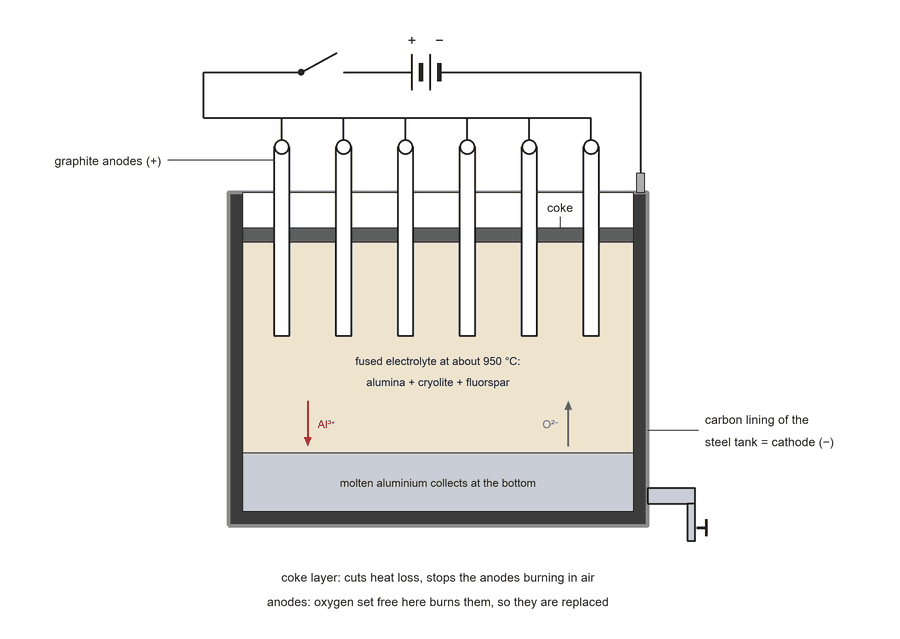
Watch out: Aluminium is collected at the CATHODE; oxygen is set free at the anodes.
Therefore, (i) cryolite lowers the fusion temperature and increases conductivity; (ii) coke reduces heat loss and stops the anodes burning in air; (iii) aluminium is collected from the cathode.
