Solution:
Concept: In the Hall–Héroult cell the electrolyte is a fused mixture of alumina (about 20%), cryolite, Na₃AlF₆ (about 60%) and fluorspar, CaF₂ (about 20%), kept at about 950 °C. Thick graphite rods dipping into it are the anodes (+), and the carbon lining of the steel tank is the cathode (−). The sketch shows this cell: Y are the graphite anodes joined to the + terminal, Z is the carbon lining joined to the − terminal, and coke is sprinkled on the surface of the electrolyte.
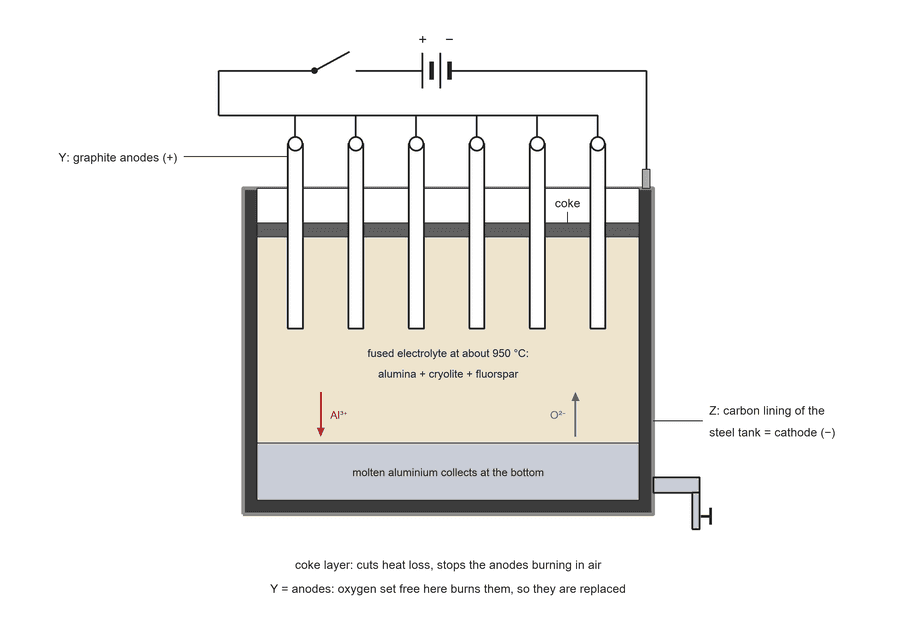
(a) Constituent with a divalent metal
Step 1 — Check the valency of each metal.
Alumina contains Al³⁺ (trivalent) and cryolite Na₃AlF₆ contains Na⁺ (monovalent) and Al³⁺. Fluorspar, CaF₂, contains Ca²⁺, which is divalent.
CaF2⇌Ca2++2F−
So the constituent is fluorspar, CaF₂.
(b) Reactions at the electrodes
Step 2 — Write the ions present.
In the molten electrolyte the alumina is split into ions.
Al2O3⇌2Al3++3O2−
Step 3 — (1) At Y, the anode.
The oxide ions lose electrons at the anode, forming oxygen atoms and then oxygen gas.
6O2−−12e−→6[O]
6[O]→3O2↑
Step 4 — (2) At Z, the cathode.
The aluminium ions gain electrons at the cathode, forming molten aluminium.
4Al3++12e−→4Al
(c) Use of sprinkling coke
Step 5 — Give a use.
The layer of powdered coke reduces the loss of heat by radiation from the surface of the electrolyte. It also prevents the hot graphite anodes from burning in the air.
Watch out: Y is joined to the + terminal, so it is the anode where oxide ions LOSE electrons.
Therefore, (a) fluorspar, CaF₂; (b) at Y: 6O²⁻ − 12e⁻ → 6[O], then 6[O] → 3O₂; at Z: 4Al³⁺ + 12e⁻ → 4Al; (c) the coke layer reduces heat loss by radiation (and stops the anodes burning in air).

