Complete the following by selecting the correct option from the choices given
Question 63 marksAsked 2017Medium
Complete the following by selecting the correct option from the choices given:
(i) The metal which does not react with water or dilute H2SO4 but reacts with concentrated H2SO4 is ............... (Al/Cu/Zn/Fe)
(ii) The metal whose oxide, which is amphoteric, is reduced to metal by carbon reduction ............... (Fe/Mg/Pb/Al)
(iii) The divalent metal whose oxide is reduced to metal by electrolysis of its fused salt is ............... (Al/Na/Mg/K)
Solution:
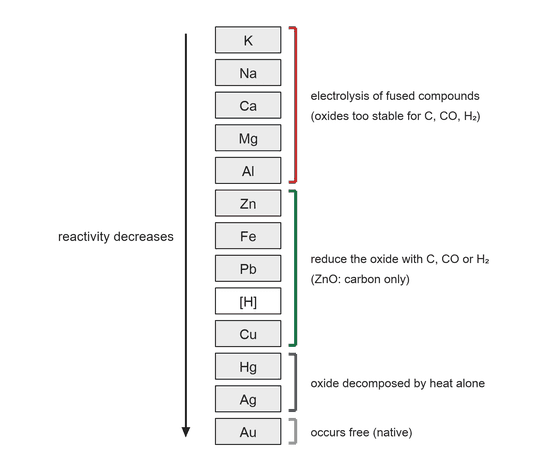
Concept: The method used to get a metal from its oxide depends on its place in the activity series: K, Na, Ca, Mg, Al, Zn, Fe, Pb, [H], Cu, Hg, Ag, Au (most reactive first). Oxides of K to Al are too stable for chemical reducing agents, so these metals are obtained by electrolysis of their fused compounds; oxides of Zn to Cu are reduced by carbon, carbon monoxide or hydrogen (zinc oxide by carbon only).
(i) Metal that reacts with concentrated but not dilute sulphuric acid
Step 1 — Test each metal.
Aluminium, zinc and iron are above hydrogen in the activity series, so they all react with dilute sulphuric acid and give hydrogen. Copper is below hydrogen, so it does not react with water or with dilute sulphuric acid.
Step 2 — See why concentrated acid works.
Hot concentrated sulphuric acid is an oxidising agent, so it does react with copper and gives sulphur dioxide.
Cu+2H2SO4ΔCuSO4+SO2↑+2H2O
The answer is Cu (copper).
(ii) Metal whose amphoteric oxide is reduced by carbon
Step 3 — Find the amphoteric oxides.
Among the four, the oxides of lead (PbO) and aluminium (Al₂O₃) are amphoteric; the oxides of iron and magnesium are basic.
Step 4 — Check which one carbon reduces.
Lead is low in the activity series, so carbon removes the oxygen from lead oxide. Aluminium oxide is too stable for carbon.
PbO+CΔPb+CO↑
The answer is Pb (lead).
(iii) Divalent metal got by electrolysis of its fused salt
Step 5 — Use the valency.
Aluminium is trivalent (Al³⁺), sodium and potassium are monovalent (Na⁺, K⁺), and magnesium is divalent (Mg²⁺). Magnesium is too reactive for carbon to reduce its oxide, so it is obtained by electrolysis of its fused salt; at the cathode:
Mg2++2e−→Mg
The answer is Mg (magnesium).
Watch out: 'Amphoteric' alone is not enough in (ii): aluminium oxide is amphoteric too, but carbon cannot reduce it.