
Question 182 marksEasy
Compare roasting and calcination.
Confirming your payment
Sign up now and get 250 free tokens.
Metallurgy · Question 18 of 85
Compare roasting and calcination.
Solution:
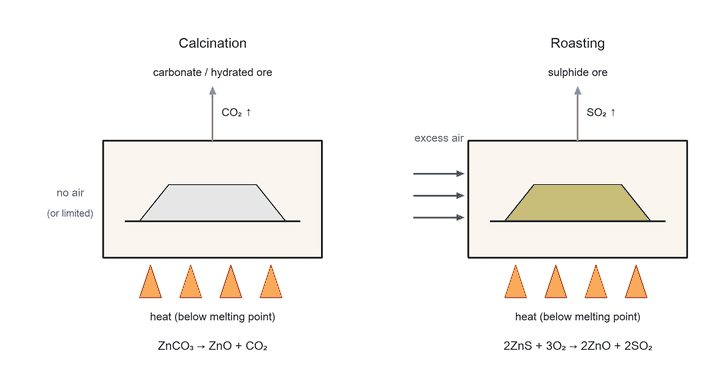
Concept: Both roasting and calcination turn a concentrated ore into its oxide, by heating below the melting point. They differ in the type of ore and in whether air is supplied.
Step 1 — Compare the two processes.
The table sets the two side by side.
| Roasting | Calcination |
|---|---|
| Ore is heated in excess of air. | Ore is heated in the absence (or a limited supply) of air. |
| Used for sulphide ores. | Used for carbonate and hydrated ores. |
| Sulphur dioxide is given off. | Carbon dioxide (or water vapour) is given off. |
| Volatile impurities are removed as oxides. | Moisture and organic matter are removed. |
Step 2 — Give an example of roasting.
Zinc blende is roasted in excess air:
Step 3 — Give an example of calcination.
Calamine is calcined in the absence of air:
Watch out: Both are done below the melting point of the ore; nothing is melted.
Therefore, roasting heats a sulphide ore in excess air (SO₂ given off), while calcination heats a carbonate or hydrated ore without air (CO₂ or water given off); both give the metal oxide.