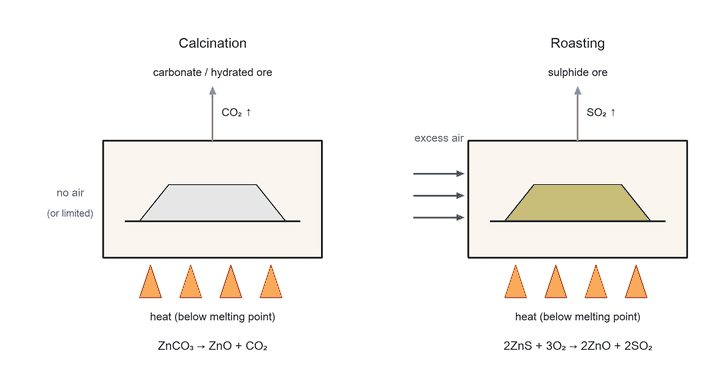
(a) Usually .................... (sulphide/carbonate) ores are subjected to .................... (calcination/roasting) which is done in the absence of air.
(b) Zinc blende is converted to oxide by .................... (roasting/calcination) process.
(c) Froth floatation process is generally used to concentrate .................... ores (sulphide/carbonate).
Solution:
Concept:Carbonate ores are calcined (no air); sulphide ores are roasted (excess air) and concentrated by froth floatation.
Step 1 — (a) Heating without air.
Heating in the absence of air is calcination, and it is used for carbonate ores, which give off carbon dioxide:
ZnCO3ΔZnO+CO2↑
Usually carbonate ores are subjected to calcination which is done in the absence of air.
Step 2 — (b) Zinc blende.
Zinc blende is a sulphide, so it is heated in excess air, giving ZnO and SO₂.
Zinc blende is converted to oxide by roasting process.
Step 3 — (c) Froth floatation.
Sulphide ore particles are wetted by oil and rise with the froth.
Froth floatation process is generally used to concentrate sulphide ores.
Watch out: Match the pairs: carbonate with calcination, sulphide with roasting.