
Question 291 markMCQEasy
Choose the correct option :
(b) A metallic oxide which cannot be reduced by normal reducing agents :
Confirming your payment
Sign up now and get 250 free tokens.
Metallurgy · Question 29 of 85
Choose the correct option :
(b) A metallic oxide which cannot be reduced by normal reducing agents :
(A) Zinc oxide
(B) Magnesium oxide
(C) Copper (II) oxide
(D) Iron (III) oxide
Answer: (B) Magnesium oxide
Concept: Normal reducing agents (C, CO, H₂) can reduce the oxides only of metals from zinc downwards in the activity series.
Step 1 — Place each metal in the series.
Of the four metals, only magnesium is above zinc; zinc, iron and copper are at or below it.
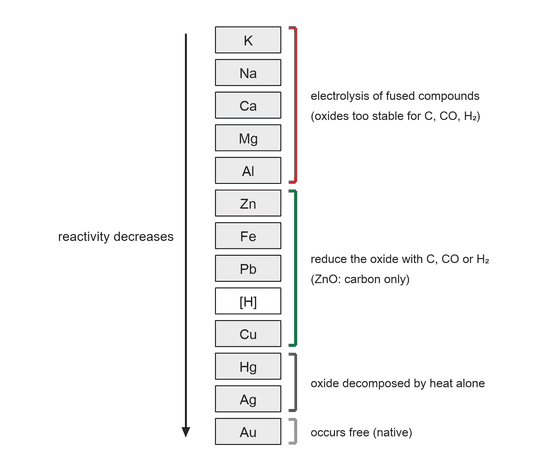
Step 2 — Decide which oxide is too stable.
Magnesium has a very strong affinity for oxygen, so MgO is too stable to be reduced by C, CO or H₂. Magnesium is obtained by electrolysis of its fused chloride.
Watch out: Zinc oxide is harder to reduce than iron or copper oxide, but carbon at about 1400 °C still reduces it.
Why the other options are wrong:
Therefore, the oxide that cannot be reduced by normal reducing agents is magnesium oxide, option (B).