Solution:
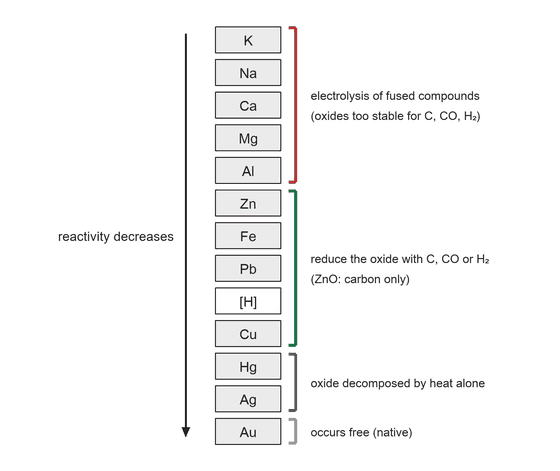
Concept: Use the activity series. For the given metals the order is Na > Mg > Zn > Fe > [H] > Cu.
Step 1 — Place the five metals in the activity series.
The full series is K > Na > Ca > Mg > Al > Zn > Fe > Pb > [H] > Cu > Hg > Ag > Au, so the given metals fall in the order sodium, magnesium, zinc, iron, then copper below hydrogen.
Step 2 — (a) The metal which does not react with dilute hydrochloric acid.
Copper lies below hydrogen, so it cannot displace hydrogen from the acid. The others do, for example zinc:
Zn+2HCl→ZnCl2+H2↑
Step 3 — (b) The metal which can form 2+ and 3+ ions.
Iron forms the ferrous ion Fe2+ and the ferric ion Fe3+, as in FeCl2 and FeCl3.
Step 4 — (c) Decreasing order of reactivity.
Reading the given metals from the top of the series downwards gives sodium > magnesium > zinc > iron > copper.
Watch out: The question asks for a different metal in (a) and (b); copper and iron are different, as required.
Therefore, (a) copper; (b) iron; (c) sodium > magnesium > zinc > iron > copper.
