
Question 75 marksEasy
(a) Why are alkali metals kept in kerosene oil ?
(b) Why is hydrogen kept in the metal activity series ?
(c) Why do gold ornaments look new even after several years of use ?
Confirming your payment
Sign up now and get 250 free tokens.
Metallurgy · Question 7 of 85
(a) Why are alkali metals kept in kerosene oil ?
(b) Why is hydrogen kept in the metal activity series ?
(c) Why do gold ornaments look new even after several years of use ?
Solution:
Concept: All three answers depend on how reactive the element is, that is, on its place in the activity series.
Step 1 — (a) Alkali metals are kept in kerosene oil.
Alkali metals such as sodium and potassium are very reactive. In air they react quickly with oxygen, carbon dioxide and water vapour, and they react violently with water.
Kerosene does not react with them, and it cuts them off from air and moisture.
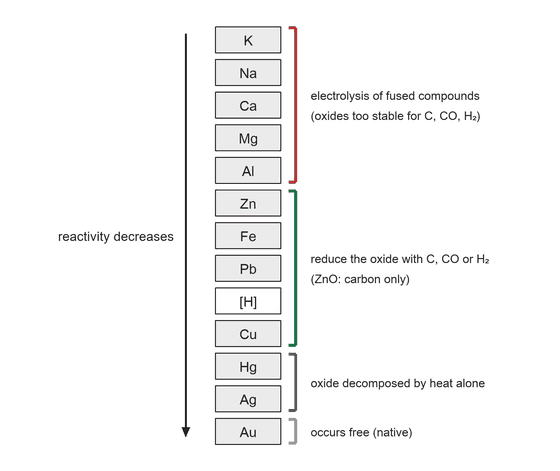
Step 2 — (b) Hydrogen is kept in the metal activity series.
Like metals, hydrogen loses an electron to form a positive ion:
It is placed between lead and copper as a reference point. Metals above hydrogen displace it from dilute acids; metals below it do not.
Step 3 — (c) Gold ornaments look new for years.
Gold is among the least reactive metals, at the bottom of the series. It does not react with air, moisture or the gases in the atmosphere, so it does not tarnish or corrode and keeps its shine.
Watch out: Kerosene is used because it is unreactive and keeps air and moisture away; water must never be used, since these metals react violently with it.
Therefore, (a) alkali metals are kept in kerosene because they react quickly with air and moisture; (b) hydrogen is kept in the series because, like metals, it forms positive ions and it is the reference for displacement from acids; (c) gold is so unreactive that it does not tarnish or corrode.