
Question 222 marksEasy
State why aluminium is extracted from its oxide by electrolysis while copper, lead, iron by reducing agents and mercury and silver by thermal decomposition.
Confirming your payment
Sign up now and get 250 free tokens.
Metallurgy · Question 22 of 85
State why aluminium is extracted from its oxide by electrolysis while copper, lead, iron by reducing agents and mercury and silver by thermal decomposition.
Solution:
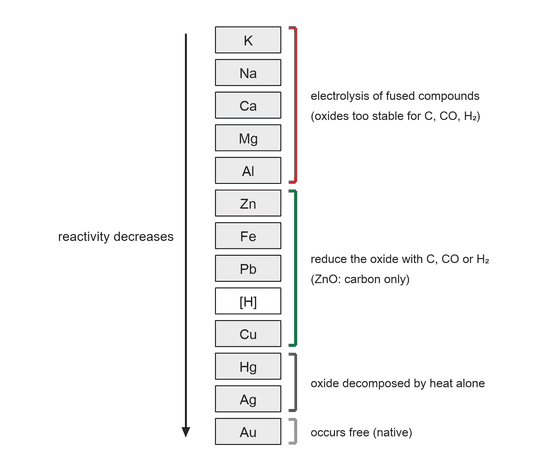
Concept: The method used to get a metal from its oxide depends on its place in the activity series: the more reactive the metal, the more strongly it holds oxygen, and the more powerful the method needed.
Step 1 — Aluminium: electrolysis.
Aluminium is highly reactive, with a very strong affinity for oxygen. Its oxide is very stable and cannot be reduced by carbon, CO or hydrogen, so it is reduced by electrolysis of fused alumina.
Step 2 — Copper, lead, iron: reducing agents.
These are moderately reactive; their oxides are less stable and are reduced by carbon, carbon monoxide or hydrogen, for example:
Step 3 — Mercury, silver: heat alone.
These are among the least reactive metals; their oxides are so unstable that they decompose on heating alone:
Watch out: The more reactive the metal, the stronger the method needed: heat alone, then reducing agents, then electrolysis.
Therefore, the method depends on reactivity: aluminium holds oxygen too strongly and needs electrolysis, copper, lead and iron oxides are reduced by C, CO or H₂, and mercury and silver oxides decompose on heating alone.