
Question 325 marksEasy
(a) Give the chemical names and formulae of main ores of (i) aluminium (ii) iron (iii) zinc.
(b) Which impurities are present in bauxite ?
(c) What is red mud, how is it removed ?
Confirming your payment
Sign up now and get 250 free tokens.
Metallurgy · Question 32 of 85
(a) Give the chemical names and formulae of main ores of (i) aluminium (ii) iron (iii) zinc.
(b) Which impurities are present in bauxite ?
(c) What is red mud, how is it removed ?
Solution:
Concept: Each of these metals has one chief ore. In Bayer's process the aluminium oxide of bauxite dissolves in caustic soda, but its impurities do not; they are left behind as red mud.
Step 1 — (a) Main ores.
The table gives the chief ore of each metal.
| Metal | Ore | Chemical name | Formula |
|---|---|---|---|
| Aluminium | Bauxite | hydrated aluminium oxide | |
| Iron | Haematite | iron(III) oxide (anhydrous ferric oxide) | |
| Zinc | Zinc blende | zinc sulphide | ZnS |
(Other ores: cryolite for aluminium, magnetite for iron, calamine for zinc.)
Step 2 — (b) Impurities in bauxite.
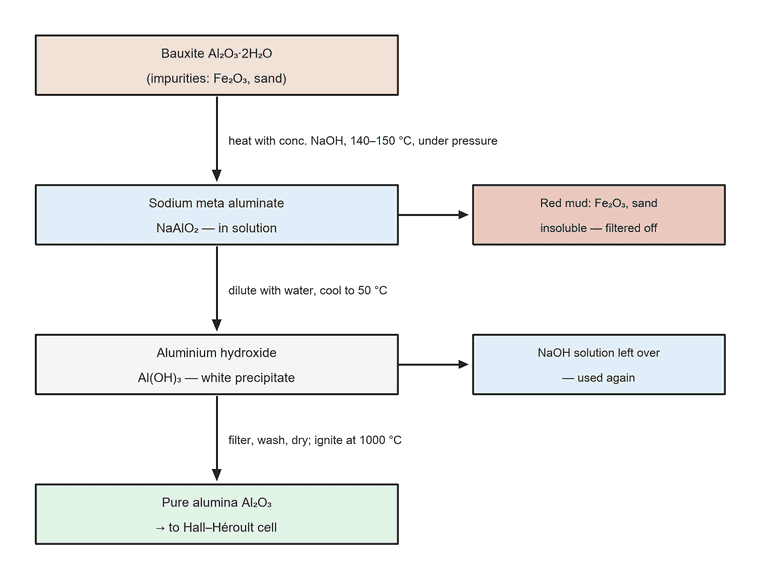
Besides aluminium oxide, bauxite contains iron(III) oxide () and sand (silica, ), with a little titanium oxide.
Step 3 — (c) Red mud: how it forms.
When bauxite is heated with concentrated caustic soda solution, the aluminium oxide dissolves as sodium meta aluminate:
Step 4 — (c) Red mud: how it is removed.
The impurities (mainly iron(III) oxide and sand) do not dissolve. This insoluble residue is red mud (red because of the iron(III) oxide), and it is removed by filtration.
Watch out: Red mud is the impurity left behind, not a product of the aluminium; it is filtered off and thrown away.
Therefore, (a) bauxite Al₂O₃·2H₂O, haematite Fe₂O₃ and zinc blende ZnS; (b) iron(III) oxide and sand; (c) red mud is the insoluble residue of iron(III) oxide and sand, removed by filtration.