In order to obtain 1 tonne of aluminium, the following inputs are required.
Question 335 marksMedium
In order to obtain 1 tonne of aluminium, the following inputs are required. 4 tonnes of bauxite, 150 kg of sodium hydroxide and 600 kg of graphite. The aluminium compound in bauxite is aluminium oxide and the main impurity is iron (III) oxide. Aluminium is obtained by the electrolysis of aluminium oxide dissolved in cryolite.
(a) When bauxite is treated with sodium hydroxide solution, what happens to :
(i) the aluminium oxide,
(ii) the iron (III) oxide ?
(b) (i) Name the process used for the purification of bauxite.
(ii) Write the equation for the action of heat on aluminium hydroxide.
(c) (i) Write the formulae of cryolite.
(ii) Write down the word which correctly completes the following sentence.
By dissolving aluminium oxide in cryolite a ......... (conducting/non conducting) solution is produced.
(iii) Why is so much graphite required for the electrolytic process ?
(iv) Write the equation for the reaction which takes place at cathode.
(v) What is the cathode made up of ?
Solution:
Concept: Alumina is amphoteric, so it dissolves in sodium hydroxide; iron(III) oxide is basic and does not. The pure alumina is then electrolysed while dissolved in molten cryolite, with graphite anodes that burn away.
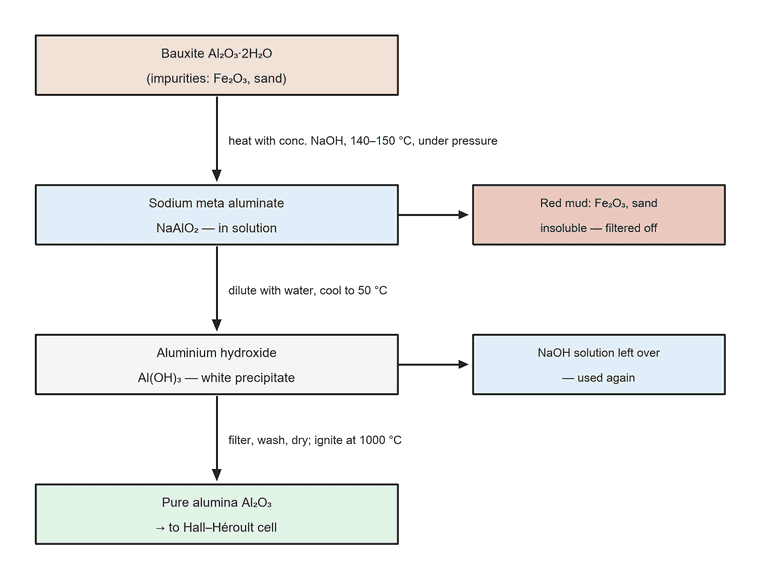
Step 1 — (a)(i) The aluminium oxide.
It dissolves, forming soluble sodium meta aluminate:
Al2O3⋅2H2O+2NaOH140–150 °C2NaAlO2+3H2O
Step 2 — (a)(ii) The iron(III) oxide.
It does not dissolve. It stays behind as an insoluble residue (red mud) and is filtered off.
Step 3 — (b)(i) Process for purifying bauxite.
This is Bayer's process.
Step 4 — (b)(ii) Action of heat on aluminium hydroxide.
On heating to about 1000 °C it loses water and gives pure alumina:
2Al(OH)31000 °CAl2O3+3H2O
Step 5 — (c)(i) Formula of cryolite.
Cryolite is sodium aluminium fluoride, Na3AlF6.
Step 6 — (c)(ii) Complete the sentence.
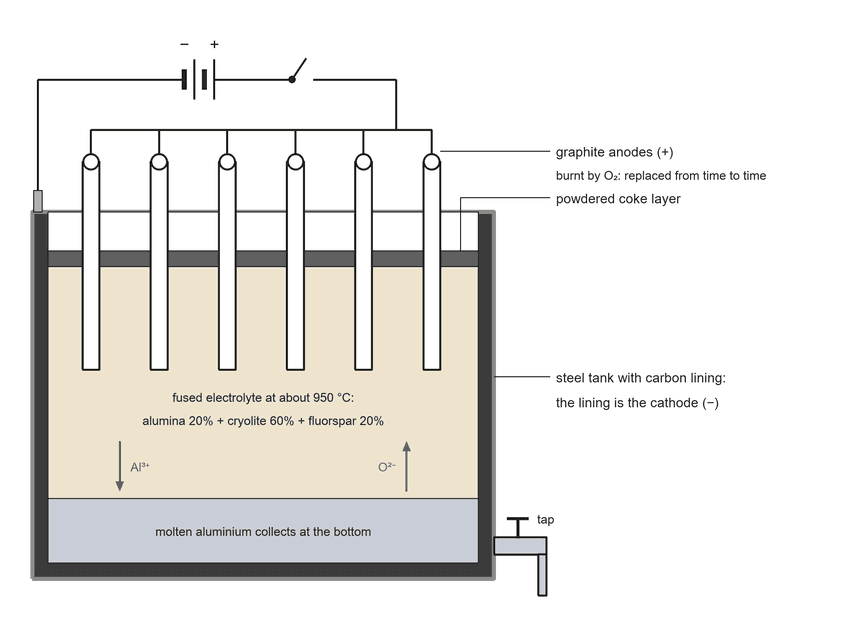
Molten cryolite dissolves alumina and conducts electricity well.
By dissolving aluminium oxide in cryolite a conducting solution is produced.
Step 7 — (c)(iii) Why so much graphite is needed.
The oxygen set free at the graphite anodes reacts with the hot graphite and burns it away as carbon monoxide and carbon dioxide:
C+O2→CO2↑
The anodes are gradually used up and have to be replaced, so a large mass of graphite (600 kg per tonne of aluminium) is needed.
Step 8 — (c)(iv) Reaction at the cathode.
Aluminium ions gain electrons and become aluminium:
Al3++3e−→Al
Step 9 — (c)(v) What the cathode is made of.
The cathode is the carbon (graphite) lining of the steel tank.
Watch out: The graphite is used up at the anode (oxygen is set free there), not at the cathode.
Therefore, (a) alumina dissolves as sodium meta aluminate while iron(III) oxide stays as red mud; (b) Bayer's process, 2Al(OH)₃ → Al₂O₃ + 3H₂O; (c) Na₃AlF₆, conducting, the anodes burn away in the oxygen set free, Al³⁺ + 3e⁻ → Al, and the cathode is the carbon lining of the tank.