
Question 375 marksEasy
For each substance listed below, explain its significance in the extraction of aluminium :
(a) Bauxite, (b) Sodium hydroxide,
(c) Cryolite, (d) Graphite. (2015)
Confirming your payment
Sign up now and get 250 free tokens.
Metallurgy · Question 37 of 85
For each substance listed below, explain its significance in the extraction of aluminium :
(a) Bauxite, (b) Sodium hydroxide,
(c) Cryolite, (d) Graphite. (2015)
Solution:
Concept: Each substance has one job: bauxite is the source, NaOH purifies it (Bayer's process), cryolite makes the electrolysis possible, and graphite forms the electrodes (Hall–Héroult process).
Step 1 — (a) Bauxite.
It is the main ore of aluminium, : the source of the alumina.
Step 2 — (b) Sodium hydroxide.
It is used in Bayer's process to dissolve the alumina (which is amphoteric) as sodium meta aluminate, separating it from the insoluble impurities (red mud):
Step 3 — (c) Cryolite.
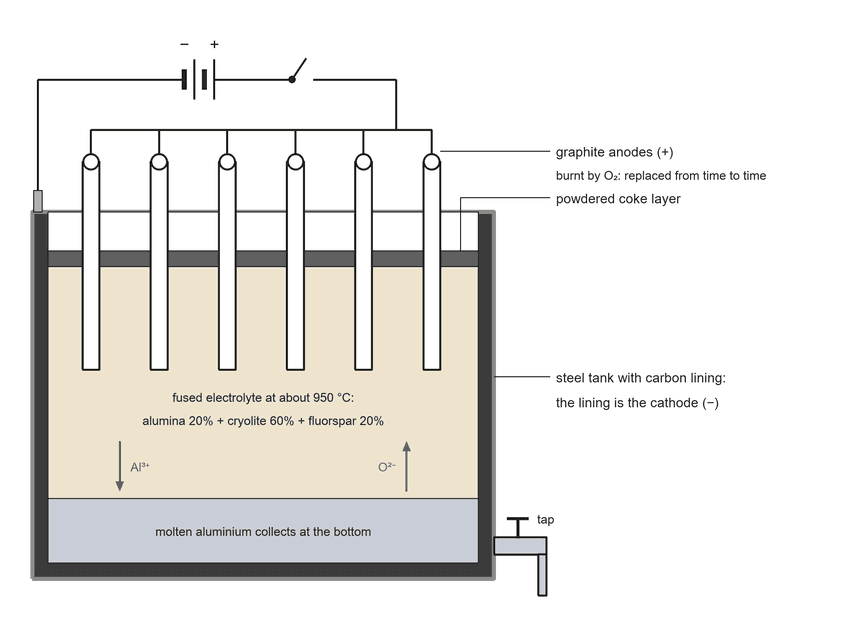
It acts as a solvent for alumina. It lowers the fusion temperature of the electrolyte from about 2050 °C to about 950 °C, and increases its electrical conductivity.
Step 4 — (d) Graphite.
Thick graphite rods dipping in the electrolyte act as the anodes; the graphite (gas carbon) lining of the tank acts as the cathode.
Watch out: Cryolite does not take part in the reaction; it is the solvent that lets alumina melt at a lower temperature.
Therefore, bauxite is the ore, sodium hydroxide purifies it to alumina, cryolite dissolves the alumina and lowers the fusion temperature, and graphite forms the anodes and the cathode lining.