(a) In the electrolytic reduction of alumina, the graphite anode is gradually consumed. OR
Why the anode has to be replaced from time to time in this process ?
(b) Roasting is carried out on sulphide ores and not on carbonate ores.
(c) Carbon can reduce lead oxide but not aluminium oxide.
(d) Electrolytic reduction is done to obtain aluminium ?
(e) Why 'the food containing iron salts' should not be cooked in aluminium utensils ?
(f) A neutral gas other than oxygen is formed at the anode during electrolysis of fused alumina.
(g) Why is powdered coke sprinkled on top of the electrolyte?
Solution:
Concept: Most of these follow from aluminium's high reactivity and its strong affinity for oxygen, and from what happens at the graphite anode.
Step 1 — (a) The graphite anode is gradually used up.
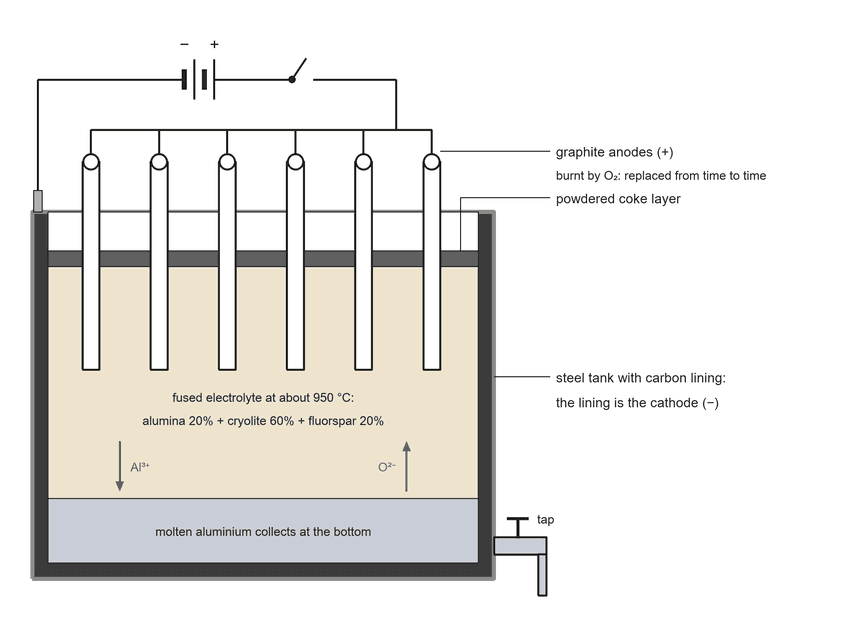
The oxygen set free at the anode reacts with the hot graphite and forms carbon monoxide and carbon dioxide, which escape:
C+O2→CO2↑
So the anode is gradually burnt away and has to be replaced from time to time.
Step 2 — (b) Roasting for sulphide ores, not carbonate ores.
A sulphide ore needs oxygen (excess air) to be converted into the oxide; the sulphur leaves as SO₂. A carbonate ore breaks down into the oxide by heat alone (calcination), so it does not need roasting:
ZnCO3ΔZnO+CO2↑
Step 3 — (c) Carbon reduces lead oxide, not aluminium oxide.
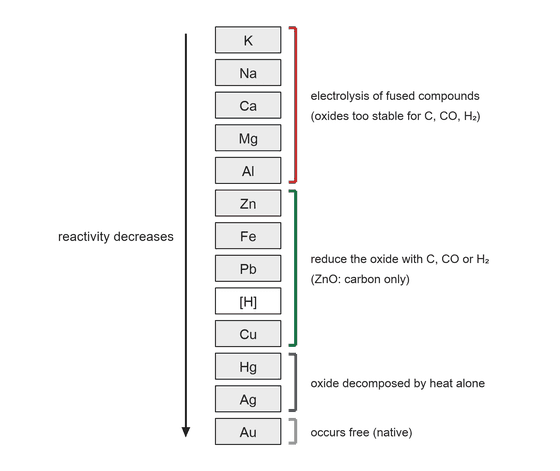
Carbon has a greater affinity for oxygen than lead, but less than aluminium. So carbon can take oxygen from lead oxide, but aluminium oxide is too stable:
PbO+CΔPb+CO↑
Step 4 — (d) Electrolytic reduction is used for aluminium.
Aluminium is a highly reactive metal with a strong affinity for oxygen. Alumina is very stable and cannot be reduced by common reducing agents such as carbon, CO or hydrogen, so electrolytic reduction is used.
Step 5 — (e) Food with iron salts is not cooked in aluminium utensils.
Aluminium is more reactive than iron, so it displaces iron from the iron salts in the food. The utensil gets corroded and aluminium salts pass into the food, which is harmful:
2Al+3FeSO4→Al2(SO4)3+3Fe
Step 6 — (f) A neutral gas other than oxygen at the anode.
The oxygen formed at the anode reacts with the carbon anode. Where oxygen is limited it forms carbon monoxide, a neutral oxide:
2C+O2→2CO↑
Step 7 — (g) Powdered coke on top of the electrolyte.
The layer of powdered coke:
reduces the loss of heat by radiation from the electrolyte; and
prevents the burning of the anodes in the air above the bath.
Watch out: Carbon dioxide is acidic, not neutral; the neutral gas in (f) is carbon monoxide.
Therefore, the anode burns in the oxygen set free; sulphides need air but carbonates do not; carbon holds oxygen more strongly than lead but less than aluminium; alumina is too stable for reducing agents; aluminium displaces iron from iron salts; the neutral gas is CO; and the coke layer cuts heat loss and protects the anodes.