
Question 541 markMCQEasy
Heating an ore in a limited supply of air or in the absence of air at a temperature just below its melting point is known as :
Confirming your payment
Sign up now and get 250 free tokens.
Metallurgy · Question 54 of 85
Heating an ore in a limited supply of air or in the absence of air at a temperature just below its melting point is known as :
(A) Smelting
(B) Ore dressing
(C) Calcination
(D) Bessemerisation
Answer: (C) Calcination
Concept: Calcination is heating an ore (carbonate or hydrated) in the absence or a limited supply of air, below its melting point, to turn it into the oxide.
Step 1 — Match the description.
Heating without air (or with little air), below the melting point, is calcination.
Step 2 — See what happens in calcination.
A carbonate ore breaks down and carbon dioxide is given off:
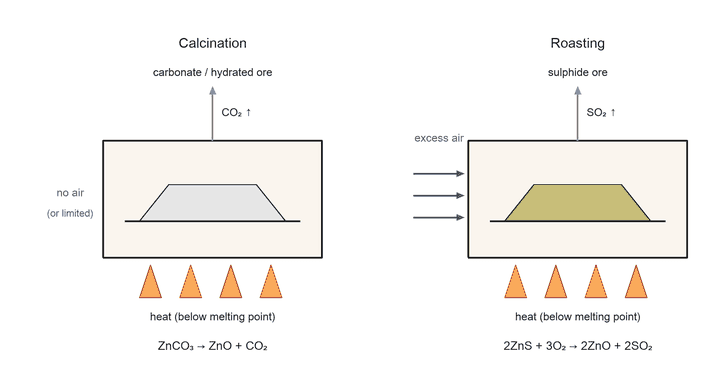
Watch out: Roasting is heating in excess air; the stem says limited air or no air, so it is calcination.
Why the other options are wrong:
Therefore, heating an ore in limited or no air just below its melting point is calcination, option (C).