
Question 104 marksEasy
Distinguish between :
(a) a mineral and an ore,
(b) an ore and a metallic compound.
Confirming your payment
Sign up now and get 250 free tokens.
Metallurgy · Question 10 of 85
Distinguish between :
(a) a mineral and an ore,
(b) an ore and a metallic compound.
Solution:
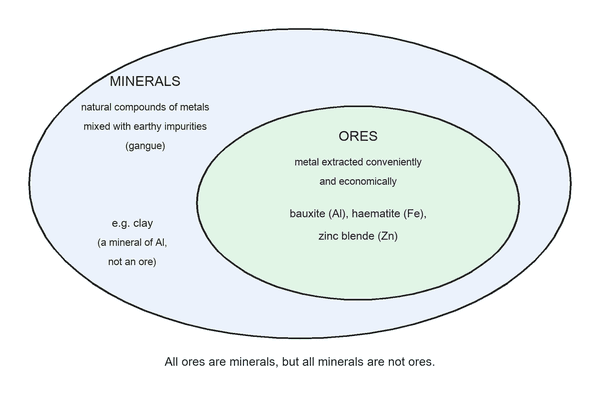
Concept: An ore is a special kind of mineral: one from which the metal can be extracted profitably. So every ore is a mineral, but not every mineral is an ore.
Step 1 — (a) Mineral and ore.
The table compares the two.
| Mineral | Ore |
|---|---|
| A naturally occurring compound of a metal, mixed with earthy impurities (gangue). | A mineral from which the metal can be extracted conveniently and economically. |
| The metal may or may not be extractable from it profitably. | Contains a good percentage of the metal. |
| e.g. clay is a mineral of aluminium. | e.g. bauxite is the ore of aluminium. |
All ores are minerals, but all minerals are not ores.
Step 2 — (b) Ore and metallic compound.
The difference is where the substance comes from and whether the metal can be extracted from it economically.
Watch out: The deciding word for an ore is profitably (economically); having the metal in it is not enough.
Therefore, (a) a mineral is any natural compound of a metal, while an ore is a mineral from which the metal is extracted profitably; (b) an ore is natural and used for extraction, while a metallic compound is any compound of a metal, often made in the laboratory.