
Question 561 markMCQEasy
Fused alumina is reduced to aluminium by electrolytic reduction, since :
Confirming your payment
Sign up now and get 250 free tokens.
Metallurgy · Question 56 of 85
Fused alumina is reduced to aluminium by electrolytic reduction, since :
(A) alumina is highly stable.
(B) alumina is least stable.
(C) alumina is not reduced by drying agents.
(D) alumina is not reduced by reducing agents.
Answer: (D) alumina is not reduced by reducing agents.
Concept: Aluminium has so strong an affinity for oxygen that common reducing agents (carbon, CO, hydrogen) cannot remove oxygen from alumina. Electrolysis is the only way left.
Step 1 — Ask why ordinary reduction fails.
Carbon, carbon monoxide and hydrogen hold oxygen less strongly than aluminium does, so they cannot reduce alumina.
Step 2 — See how electrolysis does it.
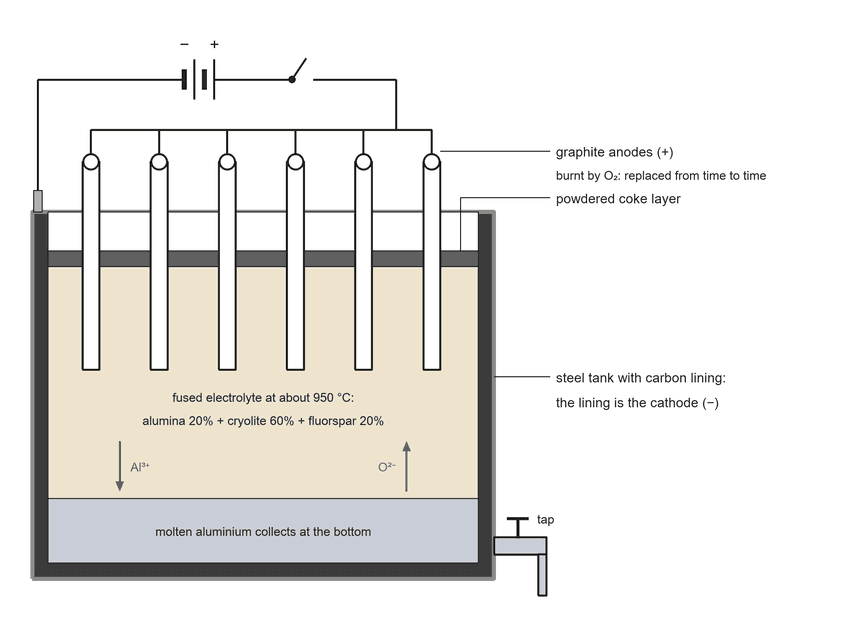
Fused alumina contains Al³⁺ and O²⁻ ions. On electrolysis, aluminium is set free at the cathode:
Watch out: The phrase 'highly stable' is true but is only the background; the stated reason for electrolysis is that reducing agents fail.
Why the other options are wrong:
Therefore, fused alumina is reduced by electrolysis since alumina is not reduced by reducing agents, option (D).