Answer: (A) (1) Both A and R are true and R is the correct explanation of A.
Concept: A reducing agent can remove oxygen only from an oxide whose metal holds oxygen less strongly than the reducing agent does.
Step 1 — Test the Assertion.
Calcium and magnesium are not obtained by reduction with carbon, CO or hydrogen; they are obtained by electrolysis of their fused chlorides. So the Assertion is true.
Step 2 — Test the Reason.
Reactive metals have a great affinity towards oxygen. So the Reason is true.
Step 3 — Does the Reason explain the Assertion.
Because Ca and Mg hold oxygen so strongly, carbon, CO or hydrogen cannot remove it. R is exactly why A happens.
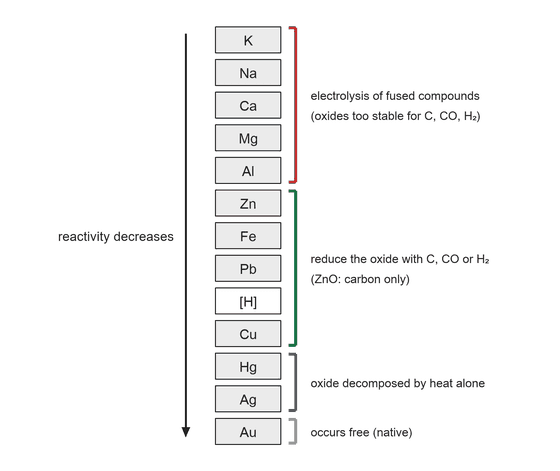
Watch out: Here 'reduction' means chemical reduction by C, CO or H₂; electrolysis also reduces the ions, but by electricity.
Why the other options are wrong:
- (B) (2) Both A and R are true but R is not the correct explanation of A: This needs both statements true with R not explaining A, but R is the correct explanation of A.
- (C) (3) A is true but R is false: This needs A true and R false, but the Reason is true.
- (D) (4) A is false but R is true: This needs A false and R true, but the Assertion is true.
Therefore, both statements are true and R is the correct explanation of A, option (A).
