
Opening your dashboard
Class 10 Chemistry Chapter 7 Metallurgy: Practice Questions
41 questions on Chapter 7, each worked through on its own page with the AI tutor. Class 10 Chemistry, ICSE 2026-27.
41 questions
1–5 marks · Mixed difficulty
- 11 mark
Question 1
Bloom's level: Remember
Which ore of zinc is a carbonate?
- 21 mark
Question 2
Bloom's level: Understand
Which statement about minerals and ores is correct?
- 31 mark
Question 3
Bloom's level: Apply
Tin stone () is often found mixed with particles of magnetite (). Which method is best suited to remove the magnetite?
- 41 mark
Question 4
Bloom's level: Remember
Which method is used to refine volatile metals with low boiling points, such as mercury and zinc?
- 51 mark
Question 5
Bloom's level: Apply
Which metal can be obtained simply by heating its oxide strongly, without any reducing agent?
- 61 mark
Question 6
Bloom's level: Understand
Gold is found in nature in the free (native) state because:
- 71 mark
Question 7
Bloom's level: Apply
In the electrolytic reduction of alumina, the electrode reactions are
When 4 moles of aluminium are deposited at the cathode, the number of moles of oxygen formed at the anode is:
- 81 mark
Question 8
Bloom's level: Analyse
Two powdered zinc ores X and Y are heated separately.
- X, heated strongly in excess air, gives off a gas that turns acidified potassium dichromate solution green.
- Y, heated in the absence of air, gives off a gas that turns lime water milky and leaves a residue that is yellow when hot and white when cold.
X and Y, and the processes, are:
- 91 mark
Question 9
Bloom's level: Apply
An electrician needs an alloy to join copper wires that melts easily under a soldering iron. Which alloy should he choose?
- 101 mark
Question 10
Bloom's level: Understand
Assertion (A): Zinc oxide is reduced to zinc by heating with coke, but not by carbon monoxide or hydrogen.
Reason (R): Carbon is a stronger reducing agent than carbon monoxide and hydrogen.
- 111 mark
Question 11
Bloom's level: Evaluate
Assertion (A): In the electrolytic reduction of alumina, the graphite anodes have to be replaced from time to time.
Reason (R): Aluminium is deposited on the anodes and has to be scraped off.
- 121 mark
Question 12
Bloom's level: Understand
Assertion (A): Mercury is stored in iron bottles.
Reason (R): Mercury is a metal that is liquid at room temperature.
- 132 marks
Question 13
Bloom's level: Remember
(a) Define a metal and a non-metal in terms of the ions they form.
(b) Which non-metal is an exception to this definition, and why?
- 141 mark
Question 14
Bloom's level: Remember
State the two conditions that a mineral must satisfy to be called an ore.
- 152 marks
Question 15
Bloom's level: Understand
Explain why haematite can be concentrated by hydraulic washing, but zinc blende is concentrated by froth flotation.
- 162 marks
Question 16
Bloom's level: Apply
Write balanced equations for:
(a) the calcination of siderite,
(b) the roasting of galena, PbS
Name the gas given off in each case.
- 172 marks
Question 17
Bloom's level: Apply
Chromium is obtained by heating chromium (III) oxide, , with aluminium powder. Write the balanced equation and explain why aluminium can reduce this oxide.
- 182 marks
Question 18
Bloom's level: Understand
Explain how liquation refines a metal, and why it is suitable for tin but not for iron.
- 192 marks
Question 19
Bloom's level: Apply
A sample of bauxite contains 60% aluminium oxide by mass. Calculate the maximum mass of aluminium that can be extracted from 1 tonne (1000 kg) of this bauxite. (Al = 27, O = 16)
- 202 marks
Question 20
Bloom's level: Apply
Explain why potassium cannot be obtained by heating its oxide with coke, and write the reactions at the electrodes when it is extracted by electrolysis of fused potassium bromide.
- 212 marks
Question 21
Bloom's level: Analyse
Calculate the percentage of zinc in pure zinc blende (ZnS) and in pure calamine (). Which mineral gives more zinc per tonne, and why? (Zn = 65, S = 32, C = 12, O = 16)
- 222 marks
Question 22
Bloom's level: Understand
Arrange the following stages of the extraction of a metal in the correct order and state the purpose of each in one line: reduction, refining, dressing of the ore, conversion of the ore to its oxide.
- 235 marks
Question 23
Bloom's level: Apply
A zinc plant in Rajasthan mines zinc blende mixed with rock and sand.
(a) Name the method used to concentrate the ore and state its principle.
(b) How is the concentrated ore converted to zinc oxide? Write the balanced equation with the condition, and give one reason why this step is needed.
(c) Write the equation for the reduction of zinc oxide with its condition, explain why coke is used rather than carbon monoxide or hydrogen, and name the method used to refine the crude zinc.
- 245 marks
Question 24
Bloom's level: Analyse
The log book of an aluminium plant shows that the voltage across a Hall–Héroult cell suddenly rose from about 5 volts to nearly 50 volts, and a lamp connected across the cell glowed brightly. Later, the graphite anodes were found to be thinner. (Al = 27, C = 12)
(a) What caused the jump in voltage, and what is done to bring it back?
(b) Explain why the anodes became thinner; give the equations.
(c) Assuming all the oxygen set free burns the anode to carbon dioxide, calculate the mass of graphite used up for every 1000 kg of aluminium produced.
- 254 marks
Question 25
Bloom's level: Evaluate
A trainee at an engineering firm suggests materials for three jobs:
(a) pure aluminium for the body panels of an aircraft;
(b) brass for surgical scissors;
(c) bronze for a statue to stand in a public park.
Judge each suggestion. Where it is poor, suggest a better alloy, giving its composition and the property that makes it suitable.
- 264 marks
Question 26
Bloom's level: Analyse
The oxides of four metals P, Q, R and S were tested.
Oxide of Heated alone Heated in hydrogen Heated with coke P gives the metal — — Q no change gives the metal gives the metal R no change no change gives the metal S no change no change no change (a) Arrange P, Q, R and S in increasing order of reactivity.
(b) Suggest which of the metals mercury, copper, zinc and aluminium could be P, Q, R and S.
(c) How would metal S be extracted? Explain.
- 274 marks
Question 27
Bloom's level: Evaluate
A student writes this plan for obtaining iron from haematite ():
Step 1: Concentrate the ore by froth flotation.
Step 2: Roast the ore in the absence of air to convert it into its oxide.
Step 3: Reduce the oxide by electrolysis of its aqueous solution.
Step 4: Refine the crude iron by distillation.
Judge each step and correct it where necessary.
- 285 marks
Question 28
Bloom's level: Create
An ore sample contains galena (PbS), some magnetite () particles and a lot of sand and clay.
(a) Design a sequence of concentration steps to obtain fairly pure galena. Name each method, state its principle, and give the reason for your order.
(b) Then plan how lead could be obtained from the concentrated galena, with balanced equations.
- 294 marks
Question 29
Bloom's level: Create
Using the activity series, construct a table for the metals potassium, calcium, zinc, iron, copper, mercury and gold showing:
(a) whether the metal is high, middle or low in the series,
(b) one form in which it occurs in nature, and
(c) a suitable method of obtaining the metal.
Then state one general rule that your table shows.
- 303 marks
Question 30
Bloom's level: Analyse
Study the properties of five elements A to E.
Element Appearance Conducts electricity? Malleable? Nature of oxide A Shiny solid Yes Yes Basic B Dull yellow solid No No (brittle) Acidic C Grey, shiny solid Yes No (brittle) Acidic D Shiny liquid Yes — Basic E Shiny grey solid Slightly No (brittle) Shows properties of both (a) Classify each element as a metal, a non-metal or a metalloid.
(b) Element C is a form of carbon. Which property of C is unusual for a non-metal, and how do you know C is still a non-metal?
(c) Name the element that D is most likely to be.
- 313 marks
Question 31
Answer the following.
(a) Name the main ore from which aluminium is extracted and write its formula.
(b) Name the chemical process by which this ore is concentrated (purified).
(c) Name the method used to concentrate a sulphide ore such as zinc blende.
- 321 mark
Question 32
In the froth floatation process, the ore is separated from the gangue because :
- 331 mark
Question 33
Which of the following statements is true of both roasting and calcination ?
- 341 mark
Question 34
Assertion (A): In the electrolytic refining of copper, the block of impure copper is made the anode.
Reason (R): Copper sulphate solution acidified with dilute sulphuric acid is used as the electrolyte in the electrolytic refining of copper.
- 352 marks
Question 35
A survey finds two deposits containing zinc carbonate. Deposit P has about 2% of zinc carbonate mixed with hard rock, deep below the ground. Deposit Q has about 40% of zinc carbonate, lies near the surface and is close to a railway line.
(i) Both deposits are minerals of zinc, but only one of them would be called an ore of zinc. Which one ? Give a reason for your answer.
(ii) Name the earthy impurities present along with an ore, and the step of metallurgy in which they are removed.
- 362 marks
Question 36
Haematite, , is the chief ore of iron. (Fe = 56, O = 16)
(i) Calculate the percentage of iron in pure haematite.
(ii) One tonne (1000 kg) of a haematite ore gives a maximum of 420 kg of iron. Calculate the percentage of in this ore.
- 372 marks
Question 37
(i) Iron (III) oxide is reduced to iron by heating it with carbon monoxide. Write the balanced equation for this reaction.
(ii) Sodium cannot be obtained from its oxide in this way. Give a reason, and name the method by which sodium is obtained.
- 382 marks
Question 38
Duralumin and stainless steel are two alloys in everyday use.
(i) For each alloy, name the main metal and one other metal present in it.
(ii) Duralumin is used for the bodies of aircraft and stainless steel for surgical instruments. State one property of each alloy which makes it more suitable for this use than its main metal alone.
- 394 marks
Question 39
Bauxite is concentrated by Baeyer's process before the metal is extracted from it. (H = 1, O = 16, Al = 27)
(i) Powdered bauxite is heated with concentrated sodium hydroxide solution. State why aluminium oxide dissolves in the alkali while the impurity iron (III) oxide is left behind.
(ii) Write balanced equations for the conversion of sodium aluminate into aluminium hydroxide, and for the action of heat on aluminium hydroxide.
(iii) Calculate the mass of pure alumina obtained when 312 kg of aluminium hydroxide is heated strongly.
- 403 marks
Question 40
The diagram shows the apparatus used to refine impure copper by electrolysis.
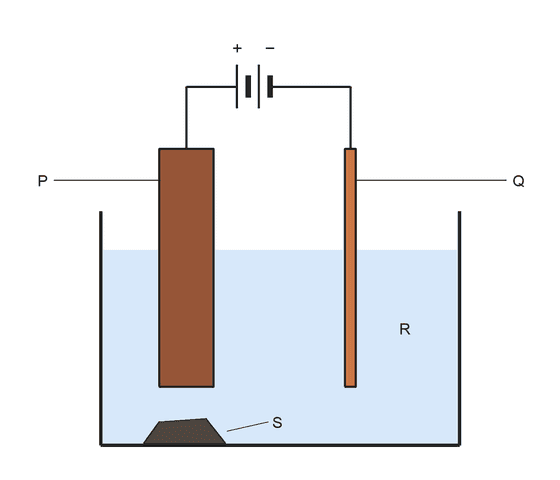
(i) Name the substances used as P, Q and R.
(ii) Write the equations for the reactions which take place at P and at Q.
(iii) What is S ? Name one metal likely to be present in it.
- 414 marks
Question 41
Pure alumina is reduced to aluminium by electrolysis in Hall-Héroult's process. (O = 16, Al = 27)
(i) The electrolyte is not alumina alone. Name the two compounds mixed with the alumina and state two ways in which they help.
(ii) Write the equations for the reactions at the cathode and at the anode.
(iii) Using these equations, calculate the mass of aluminium formed at the cathode in the time in which 48 kg of oxygen is set free at the anode.