
Question 204 marksEasy
(a) Some metallic oxides can be reduced by hydrogen, carbon and carbon monoxide and some cannot. Explain.
(b) Write balanced equation for the reduction of copper (II) oxide by hydrogen. (2019)
Confirming your payment
Sign up now and get 250 free tokens.
Metallurgy · Question 20 of 85
(a) Some metallic oxides can be reduced by hydrogen, carbon and carbon monoxide and some cannot. Explain.
(b) Write balanced equation for the reduction of copper (II) oxide by hydrogen. (2019)
Solution:
Concept: A reducing agent can take oxygen away only from the oxide of a metal that holds oxygen less strongly than the reducing agent does. How strongly a metal holds oxygen follows the activity series.
Step 1 — (a) Oxides that can be reduced.
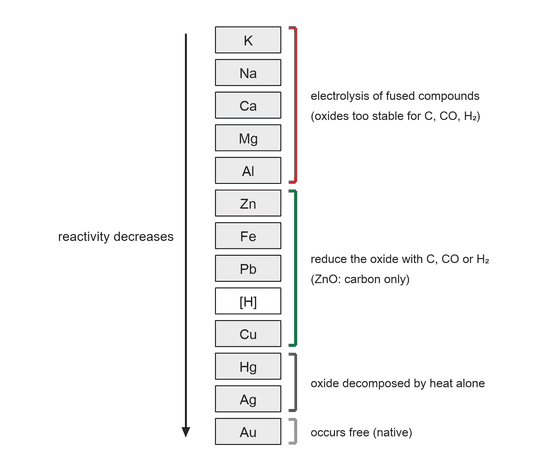
Oxides of less reactive metals (zinc, iron, lead, copper) are less stable. Hydrogen, carbon or carbon monoxide can remove their oxygen. (Zinc oxide is reduced by carbon at about 1400 °C.)
Step 2 — (a) Oxides that cannot be reduced.
Oxides of highly reactive metals (K, Na, Ca, Mg, Al) are very stable, because these metals have a very strong affinity for oxygen. Common reducing agents cannot reduce them, so these metals are obtained by electrolysis.
Step 3 — (b) Reduction of copper(II) oxide by hydrogen.
Hydrogen takes the oxygen from the heated oxide and forms water; the black oxide turns reddish-brown copper.
Watch out: The deciding factor is the metal's affinity for oxygen, that is, its place in the activity series.
Therefore, (a) oxides of less reactive metals are reduced by H₂, C or CO, but oxides of very reactive metals are too stable and need electrolysis; (b) CuO + H₂ → Cu + H₂O.