
Opening your dashboard
Class 10 Chemistry Chapter 2 Chemical Bonding: Previous Year Questions
52 questions on Chapter 2, each solved step by step. Class 10 Chemistry, ICSE 2026-27.
52 questions with solutions
1–5 marks · Mixed difficulty
- 11 mark
Question 1
Fill in the blanks with the choices given in brackets.
Electrovalent compounds have ............... (high/low) melting points.
Solve with AIWritten solution
Solution:
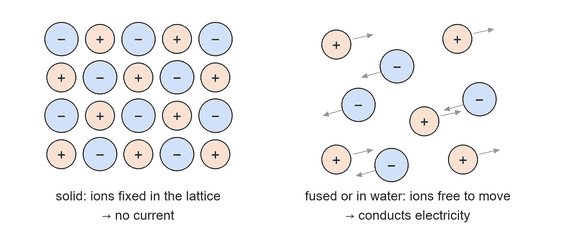
Concept: In an electrovalent (ionic) compound, positive and negative ions are packed in a regular crystal lattice and held in place by strong electrostatic forces of attraction in all directions. To melt the solid, these forces must be overcome so that the ions can leave their fixed places.
Step 1 — Recall what holds the compound together.
An electrovalent compound is not made of separate molecules; it is a giant lattice of ions such as and , each ion attracted by all the oppositely charged ions around it.
Step 2 — Decide how much energy melting needs.
Because these electrostatic forces are strong and act throughout the whole crystal, a large amount of heat energy is needed to break the lattice. Sodium chloride, for example, melts only at about 801 °C.
Step 3 — Fill in the blank.
A large amount of energy means a high temperature, so the correct choice from the brackets is high.
Watch out: Do not mix up 'electrovalent' (ions, high melting points) with 'covalent' (molecules, low melting points).
Therefore, electrovalent compounds have high melting points.
- 21 mark
Question 2
An element with the atomic number 19 will most likely combine chemically with the element whose atomic number is:
Solve with AIAnswer
- Correct
(A) 17
(B) 11
(C) 18
(D) 20
Answer: (A) 17
Concept: An atom with one valence electron loses it easily to reach a stable octet, so it combines with an atom that needs exactly one more electron to complete its octet. The bond formed by this transfer is electrovalent.
Step 1 — Identify the element with atomic number 19.
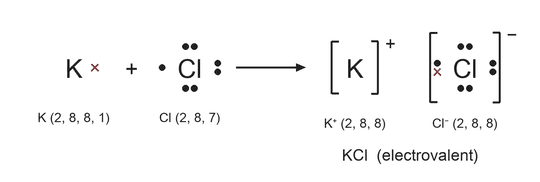
We write its configuration by filling the shells 2, 8, 8 … in turn. Atomic number 19 is potassium, configuration 2, 8, 8, 1, so it has 1 valence electron, which it loses to form .
Step 2 — Look for an atom that needs one electron.
Atomic number 17 is chlorine, configuration 2, 8, 7. It has 7 valence electrons and needs just one more to complete its octet, so it accepts potassium's electron.
Step 3 — Name the compound.
The electron moves from K to Cl; the ions (2, 8, 8) and (2, 8, 8) attract each other and form potassium chloride, KCl, an electrovalent compound.
Watch out: Atomic number 18 or 20 is next to 19 in number, but closeness in atomic number says nothing about bonding; look at the valence electrons.
Why the other options are wrong:
- (B) 11: atomic number 11 is sodium (2, 8, 1), a metal that also wants to lose one electron, so it cannot accept potassium's electron and no ionic compound forms.
- (C) 18: atomic number 18 is argon (2, 8, 8), a noble gas whose octet is already complete; it neither gains nor loses electrons.
- (D) 20: atomic number 20 is calcium (2, 8, 8, 2), a metal that loses its own two electrons; it does not accept potassium's electron.
Therefore, the element with atomic number 19 (potassium) combines with atomic number 17 (chlorine), option (A).
- 34 marks
Question 3
The following table shows the electronic configuration of the elements W, X, Y, Z:
Element W X Y Z Electronic configurations 2,8,1 2,8,7 2,5 1 (i) What type of bond is formed between:
-
W and X
-
Y and Z
(ii) What is the formula of the compound formed between :
-
X and Z
-
W and X
Solve with AIWritten solution
Solution:
Concept: The number of valence (outermost) electrons decides how an atom bonds. A metal atom (1 to 3 valence electrons) and a non-metal atom (5 to 7) form an electrovalent bond by transfer of electrons; two non-metal atoms form a covalent bond by sharing pairs of electrons. Hydrogen (1 electron) needs one more for a duplet.
Step 1 — Identify each element from its configuration.
We count the electrons in the outermost shell of each atom and use the total to name it:
Element Configuration Valence electrons Atomic number Element is Type W 2, 8, 1 1 11 sodium metal: loses 1 X 2, 8, 7 7 17 chlorine non-metal: needs 1 Y 2, 5 5 7 nitrogen non-metal: needs 3 Z 1 1 1 hydrogen non-metal: needs 1 (duplet) Step 2 — (i) 1. Bond between W and X.
W is a metal and X a non-metal, so W transfers its one valence electron to X. W becomes and X becomes , and the two ions attract each other: this is an electrovalent (ionic) bond.
Step 3 — (i) 2. Bond between Y and Z.
Y and Z are both non-metals, so they share electrons. Y needs 3 electrons and each Z needs 1, so Y shares one pair with each of three Z atoms (like ammonia, ): this is a covalent bond.
Step 4 — (ii) 1. Formula of the compound of X and Z.
X needs one electron and Z needs one electron, so one X and one Z share a single pair (like hydrogen chloride, HCl). The formula is ZX (written with Z, the hydrogen-like element, first, as in HCl).
Step 5 — (ii) 2. Formula of the compound of W and X.
W loses one electron and X gains one, so the charges +1 and −1 cancel in a 1 : 1 ratio (like NaCl). The formula is WX.

Watch out: Z has only one electron, so it is hydrogen, a non-metal; do not treat it like the metal W just because both have one outer electron.
Therefore, (i) 1. W and X form an electrovalent (ionic) bond, 2. Y and Z form a covalent bond; (ii) 1. X and Z form ZX (or XZ), 2. W and X form WX.
-
- 42 marks
Question 4
By drawing an electron dot diagram show the formation of ammonium ion [N = 7, H = 1]
Solve with AIWritten solution
Solution:
Concept: A coordinate (dative) bond is a covalent bond in which both electrons of the shared pair come from the same atom (the donor, which has a lone pair) and are accepted by an atom or ion that is short of a pair (the acceptor, such as ). It is shown by an arrow from the donor to the acceptor.
Step 1 — Draw ammonia first.
Nitrogen (atomic number 7, configuration 2, 5) has 5 valence electrons. It shares one electron with each of three hydrogen atoms, forming three single covalent N–H bonds. This uses 3 of its 5 electrons, so one pair (2 electrons) is left unshared: the lone pair.
Step 2 — Look at the hydrogen ion.
A hydrogen ion, , is a hydrogen atom that has lost its only electron. It has an empty shell and needs a pair of electrons to get a stable duplet.
Step 3 — Form the ammonium ion.
The nitrogen atom donates its lone pair to the hydrogen ion, and the pair is now shared between N and the fourth H. Both electrons of this bond come from nitrogen, so it is a coordinate bond.
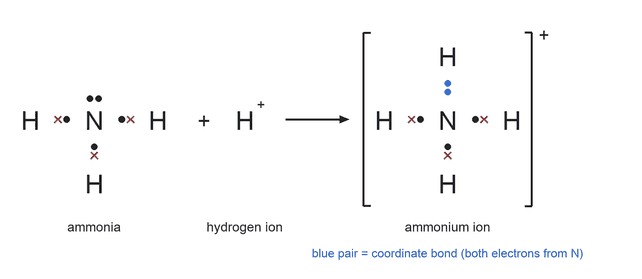
In the diagram the dots are nitrogen's electrons and the crosses are hydrogen's; the blue pair is the donated lone pair (coordinate bond).
Step 4 — Describe the ion formed.
The ammonium ion has three covalent N–H bonds and one coordinate N→H bond, no lone pair on nitrogen, and one positive charge, which it got from the ion. Once it is formed, all four N–H bonds are exactly alike.
Watch out: The positive charge belongs to the whole ion, so draw a square bracket round the structure with + outside it.
Therefore, NH₃ + H⁺ → NH₄⁺: the lone pair of nitrogen in ammonia is donated to H⁺, giving the ammonium ion with three covalent bonds and one coordinate bond.
- 51 mark
Question 5
Fill in the blanks from the choices given in brackets:
The compound that does not have a lone pair of electrons is .............. (water, ammonia, carbon tetra chloride)
Solve with AIWritten solution
Solution:
Concept: A lone pair is a pair of valence electrons on an atom that is not shared with any other atom. To find lone pairs on the central atom, subtract the electrons it uses in bonds from its valence electrons.
Step 1 — Count for water.
Oxygen has 6 valence electrons and uses 2 of them in its two O–H bonds, so 4 electrons, that is two lone pairs, are left on oxygen.
Step 2 — Count for ammonia.
Nitrogen has 5 valence electrons and uses 3 in its three N–H bonds, so 2 electrons, that is one lone pair, are left on nitrogen.
Step 3 — Count for carbon tetrachloride.
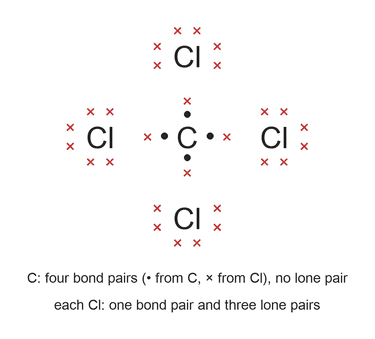
Carbon (configuration 2, 4) has 4 valence electrons and uses all 4 in its four C–Cl bonds, so no lone pair is left on carbon.
Step 4 — Fill in the blank.
Of the three compounds, only carbon tetrachloride has no lone pair on its central atom.
Watch out: Each chlorine atom in CCl₄ still carries three lone pairs (see the figure); the question is about the central carbon atom, which has none.
Therefore, the compound that does not have a lone pair of electrons is carbon tetrachloride.
- 61 mark
Question 6
Which of the following is a common characteristic of a covalent compound?
Solve with AIAnswer
(A) high melting point
- Correct
(B) consists of molecules
(C) always soluble in water
(D) conducts electricity when it is in the molten state
Answer: (B) consists of molecules
Concept: A covalent bond forms when two atoms (usually of non-metals) share one or more pairs of electrons, each atom putting the same number of electrons into the shared pair(s). Each atom counts the shared electrons in its own outer shell, and so reaches a noble gas configuration. The atoms joined in this way form separate units called molecules.
Step 1 — Look at what a covalent compound is made of.
Inside each molecule the atoms are held together by strong covalent bonds, but the molecule as a whole has no charge, so a covalent compound is a collection of molecules, not of ions.
Step 2 — See how this explains its usual properties.
Between the molecules there are only weak forces of attraction. This is why covalent compounds are usually gases, liquids or soft solids with low melting points, and why they have no ions to carry a current.
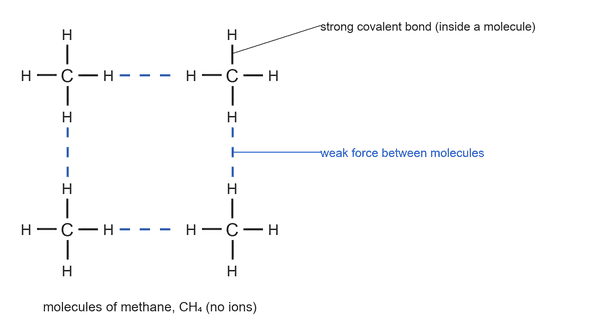
Step 3 — Pick the characteristic true of every covalent compound.
Being made of molecules is the one feature shared by all simple covalent compounds, so option (B) is the common characteristic.
Watch out: "Always" in an option is a strong word; one counter-example (such as carbon tetrachloride, which does not mix with water) is enough to reject it.
Why the other options are wrong:
- (A) high melting point: a high melting point belongs to electrovalent compounds; the weak forces between covalent molecules give covalent compounds low melting points.
- (C) always soluble in water: many covalent compounds, such as carbon tetrachloride and methane, hardly dissolve in water (they dissolve in organic solvents); only some, such as sugar, ethanol, HCl and NH₃, dissolve, so 'always' is false.
- (D) conducts electricity when it is in the molten state: conduction in the molten state is a property of electrovalent compounds; a molten covalent compound has no free ions, so it does not conduct.
Therefore, a common characteristic of a covalent compound is that it consists of molecules, option (B).
- 72 marks
Question 7
State the type of Bonding in the following molecules:
(i) Water
(ii) Calcium oxide
Solve with AIWritten solution
Solution:
Concept: Two non-metal atoms bond by sharing electron pairs (covalent bond). A metal atom and a non-metal atom bond by transfer of electrons from the metal to the non-metal (electrovalent or ionic bond).
Step 1 — (i) Decide the bonding in water.
Water is made of oxygen and hydrogen, both non-metals. Oxygen (2, 6) needs 2 electrons and each hydrogen needs 1, so oxygen shares one pair with each of two hydrogen atoms: covalent bonding.
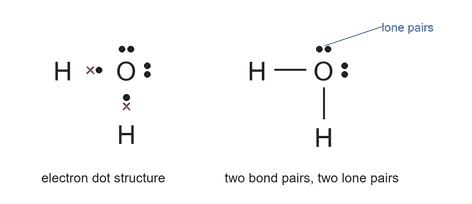
Step 2 — (i) Say what kind of covalent bond it is.
Oxygen is more electronegative than hydrogen (3.5 against 2.1 on the Pauling scale), so it pulls each shared pair towards itself. The O–H bonds are therefore polar covalent.
Step 3 — (ii) Decide the bonding in calcium oxide.
Calcium (2, 8, 8, 2) is a metal with 2 valence electrons, and oxygen (2, 6) is a non-metal that needs 2. Calcium transfers both electrons to oxygen:
The ions (2, 8, 8) and (2, 8) are held by strong electrostatic attraction: electrovalent (ionic) bonding.
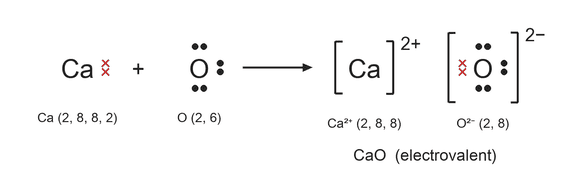
Watch out: The question says 'molecules', but calcium oxide is not made of molecules at all; it is a lattice of ions.
Therefore, (i) water has covalent (polar covalent) bonding; (ii) calcium oxide has electrovalent (ionic) bonding.
- 84 marks
Question 8
Draw an electron dot diagram to show the formation of each of the following compounds:
(i) Methane
(ii) Magnesium Chloride
[H = 1, C = 6, Mg = 12, Cl = 17]
Solve with AIWritten solution
Solution:
Concept: Methane is formed by sharing electrons (covalent bonds), and magnesium chloride by transfer of electrons (electrovalent bonds). In an electron dot diagram the dots show the electrons of one atom and the crosses those of the other, so we can see where each electron came from.
Step 1 — (i) Work out the electrons in methane.
Carbon (atomic number 6, configuration 2, 4) has 4 valence electrons and needs 4 more for an octet. Each hydrogen (atomic number 1) has 1 electron and needs 1 more for a duplet.
Step 2 — (i) Draw methane.
Carbon shares one of its electrons with each of four hydrogen atoms, so four single covalent bonds (four shared pairs) are formed.

Carbon now has 4 + 4 = 8 electrons around it (an octet), and each hydrogen has 2 (a duplet).
Step 3 — (ii) Work out the electron transfer in magnesium chloride.
Magnesium (2, 8, 2) has 2 valence electrons, and each chlorine (2, 8, 7) needs 1. So magnesium gives one electron to each of two chlorine atoms:
Step 4 — (ii) Draw magnesium chloride.
The ions formed are (2, 8) and two ions (2, 8, 8), each with a stable octet, held together by electrostatic attraction.
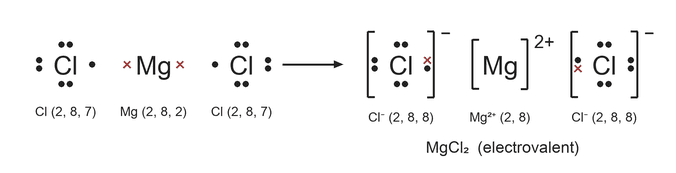
Watch out: In MgCl₂ draw TWO chloride ions, each in its own bracket with a − charge, and the magnesium ion with 2+.
Therefore, methane has four C–H single covalent bonds (C shares one electron with each of four H atoms), and magnesium chloride is Mg²⁺ with two Cl⁻ ions, formed by Mg giving one electron to each Cl atom.
- 91 mark
Question 9
Fill up the blanks with the correct choice given in brackets.
Ionic or electrovalent compounds do not conduct electricity in their ............... state. (fused / solid)
Solve with AIWritten solution
Solution:
Concept: An electric current passes through a liquid or a solution only if it contains ions that are free to move. Positive ions (cations) move to the cathode (negative electrode) and negative ions (anions) move to the anode (positive electrode). An ionic compound already contains ions, but they can carry a current only if they are free to move.
Step 1 — Look at the ions in the solid.
In the solid state the ions sit in fixed positions in the crystal lattice, held by strong electrostatic forces. They can vibrate but cannot move through the solid, so they cannot carry a current.
Step 2 — Look at the ions in the fused state.
When the compound is fused (melted), the lattice breaks down and the ions become free to move, so the melt conducts electricity. The same happens when the compound is dissolved in water.
Step 3 — Fill in the blank.
The compound does not conduct in the state where its ions are fixed, which is the solid state.
Watch out: An ionic solid has ions but still does not conduct; conduction needs MOBILE ions, not just ions.
Therefore, ionic or electrovalent compounds do not conduct electricity in their solid state.
- 103 marks
Question 10
(i) What do you understand by a lone pair of electrons?
(ii) Draw the electron dot diagram of Hydronium ion. (H=1; O=8)
Solve with AIWritten solution
Solution:
Concept: After bonding, an atom may still have pairs of valence electrons that are not used in any bond; these are lone pairs. A lone pair can be donated to an ion such as to form a coordinate bond.
Step 1 — (i) Define a lone pair.
A lone pair of electrons is a pair of valence electrons on an atom that is not shared with any other atom during bond formation.
Step 2 — (i) Give an example.
In ammonia, nitrogen uses 3 of its 5 valence electrons in N–H bonds, so one pair is left unshared: one lone pair. In water, oxygen uses 2 of its 6, so it has two lone pairs.

Step 3 — (ii) Start the hydronium ion from water.
In water, oxygen (2, 6) shares one pair with each of two hydrogen atoms and keeps two lone pairs. The oxygen atom donates one of these lone pairs to a hydrogen ion, which has no electron:
Step 4 — (ii) Draw and describe the hydronium ion.
The donated pair now forms a coordinate bond between O and the third H.
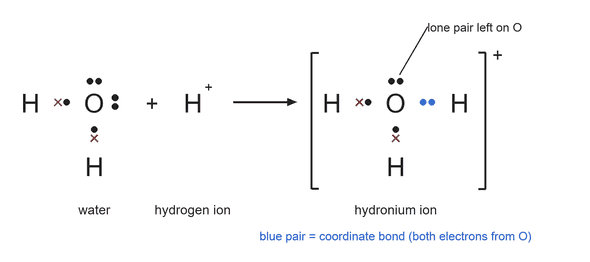
The hydronium ion has two covalent O–H bonds and one coordinate bond, one lone pair is left on oxygen, and the ion carries one positive charge (shown outside the bracket).
Watch out: After forming H₃O⁺, oxygen still has ONE lone pair (it had two and gave away one).
Therefore, (i) a lone pair is a pair of valence electrons on an atom that is not shared with any other atom; (ii) H₃O⁺ is formed when the oxygen of water donates a lone pair to H⁺, giving two covalent bonds, one coordinate bond and one lone pair on oxygen.
- 111 mark
Question 11
Give the appropriate term defined by the statements given below:
The covalent bond in which the electrons are shared equally between the combining atoms.
Solve with AIWritten solution
Solution:
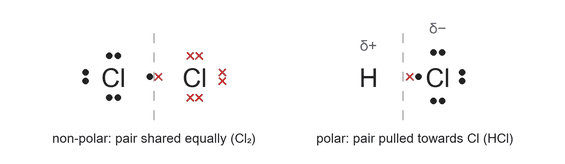
Concept: Electronegativity is the tendency of an atom to attract a shared pair of electrons towards itself. If the two bonded atoms have equal electronegativity, the pair is shared equally and the bond is non-polar; if one is more electronegative, it pulls the pair closer, gets a partial negative charge (δ−) and the other a partial positive charge (δ+), and the bond is polar.
Step 1 — Decide when sharing is equal.
Electrons are shared equally when the two atoms attract the shared pair equally strongly, which happens when both atoms are of the same element (or have the same electronegativity).
Step 2 — See what this does to the bond.
The shared pair then lies exactly midway between the two nuclei, so no partial charges (δ+ or δ−) develop, as in , and .
Step 3 — Name the bond.
A covalent bond with no partial charges is called a non-polar covalent bond.
Watch out: 'Covalent bond' alone is not enough here; the statement describes the special case of EQUAL sharing.
Therefore, the covalent bond in which the electrons are shared equally is a non-polar covalent bond.
- 123 marks
Question 12
Draw the electron dot structure of:
(i) Nitrogen molecule [N = 7]
(ii) Sodium chloride [Na = 11, Cl = 17]
(iii) Ammonium ion [N = 7, H = 1]
Solve with AIWritten solution
Solution:
Concept: The nitrogen molecule forms by sharing (covalent bonds); sodium chloride by transfer of an electron (electrovalent bond); the ammonium ion by a lone pair being donated to (coordinate bond). Dots and crosses show which atom each electron came from.
Step 1 — (i) Work out the sharing in the nitrogen molecule.
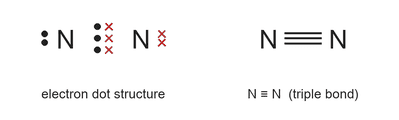
Each nitrogen atom (2, 5) has 5 valence electrons and needs 3 more for an octet. So each atom puts 3 electrons into the bond and the two atoms share three pairs: a triple covalent bond, N≡N.
Step 2 — (i) Draw the nitrogen molecule.
Each nitrogen keeps its remaining two electrons as one lone pair, so each atom has 6 shared + 2 = 8 electrons.
Step 3 — (ii) Work out the transfer in sodium chloride.
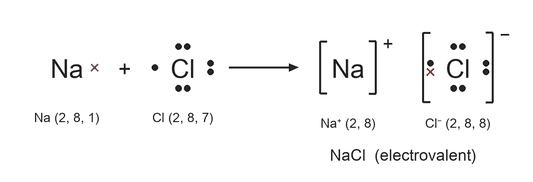
Sodium (2, 8, 1) gives its one valence electron to chlorine (2, 8, 7):
Step 4 — (ii) Draw sodium chloride.
The ions (2, 8) and (2, 8, 8) both have a stable octet and are held by electrostatic attraction.
Step 5 — (iii) Draw the ammonium ion.
The lone pair on the nitrogen of ammonia is donated to a hydrogen ion:
The ion has three covalent N–H bonds and one coordinate bond (blue pair, both electrons from N), no lone pair on nitrogen, and a single positive charge.
Watch out: N₂ needs THREE shared pairs and a lone pair on each N; drawing only one or two shared pairs leaves nitrogen without an octet.
Therefore, (i) N₂ has a triple covalent bond with one lone pair on each N; (ii) NaCl is Na⁺ and Cl⁻ formed by the transfer of one electron; (iii) NH₄⁺ has three covalent N–H bonds and one coordinate bond.
- 131 mark
Question 13
A compound with low boiling point, is:
Solve with AIAnswer
(A) Sodium chloride
(B) Calcium chloride
(C) Potassium chloride
- Correct
(D) Carbon tetrachloride
Answer: (D) Carbon tetrachloride
Concept: Electrovalent compounds are made of ions held by strong electrostatic forces in a crystal lattice; covalent compounds are made of molecules, and the forces between molecules are weak. Almost every difference in their properties (state, melting and boiling points, solubility, conductivity) follows from this. So covalent compounds have low melting and boiling points, and electrovalent compounds high ones.
Step 1 — Classify the three metal chlorides.
Sodium chloride, calcium chloride and potassium chloride are each formed from a metal and chlorine by the transfer of electrons, so they are electrovalent: lattices of ions held by strong forces.
Step 2 — Classify carbon tetrachloride.
Carbon tetrachloride, , is formed from two non-metals by sharing electrons, so it is a covalent compound made of molecules with only weak forces between them.
Step 3 — Compare the boiling points.
Little energy is needed to separate the molecules of CCl₄, so it is a liquid that boils at about 77 °C, while the three chlorides boil only well above 1000 °C.
Watch out: All four compounds contain chlorine; it is the OTHER element (metal or non-metal) that decides the bond type.
Why the other options are wrong:
- (A) Sodium chloride: sodium chloride is electrovalent; its strong forces between Na⁺ and Cl⁻ ions give it a high boiling point (about 1413 °C).
- (B) Calcium chloride: calcium chloride is electrovalent (Ca²⁺ and Cl⁻ ions), so its boiling point is high.
- (C) Potassium chloride: potassium chloride is electrovalent (K⁺ and Cl⁻ ions), so its boiling point is high.
Therefore, the compound with a low boiling point is carbon tetrachloride, option (D).
- 141 mark
Question 14
Give one word or a phrase for the following statements:
(i) The chemical bond formed by a shared pair of electrons, each bonding atom contributing one electron to the pair.
Solve with AIWritten solution
Solution:
Concept: A covalent bond forms when two atoms (usually of non-metals) share one or more pairs of electrons, each atom putting the same number of electrons into the shared pair(s). Each atom counts the shared electrons in its own outer shell, and so reaches a noble gas configuration. One shared pair of electrons makes one bond.
Step 1 — Read the statement.
The statement describes one shared pair to which each bonded atom gives one electron.
Step 2 — Match it with a bond type.
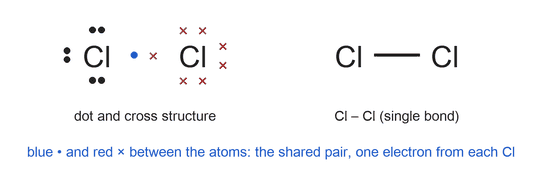
Sharing in which each atom contributes one electron is a covalent bond, and one shared pair is a single bond. In the chlorine molecule, for example, each Cl atom contributes one electron, and the shared pair gives both atoms an octet (Cl–Cl).
Step 3 — Name the bond.
The bond described is therefore a single covalent bond.
Watch out: If BOTH electrons of the shared pair came from one atom, the bond would be a coordinate bond instead.
Therefore, the chemical bond described is a single covalent bond (a covalent bond).
- 151 mark
Question 15
Fill in the blanks from the choices given in brackets:
(i) The polar covalent compound in gaseous state that does not conduct electricity is ...............
(carbon tetra chloride, ammonia, methane)
Solve with AIWritten solution
Solution:
Concept: Electronegativity is the tendency of an atom to attract a shared pair of electrons towards itself. If the two bonded atoms have equal electronegativity, the pair is shared equally and the bond is non-polar; if one is more electronegative, it pulls the pair closer, gets a partial negative charge (δ−) and the other a partial positive charge (δ+), and the bond is polar. A substance conducts only if it contains free ions (or free electrons).
Step 1 — Sort the three choices by polarity.
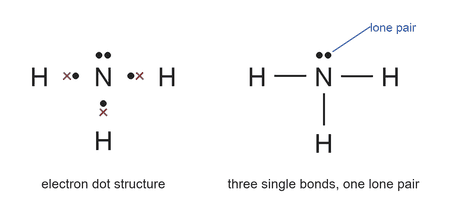
In ammonia, nitrogen (electronegativity 3.0) pulls the shared pairs more than hydrogen (2.1) does, and the molecule is not symmetrical, so ammonia is polar. Methane and carbon tetrachloride are symmetrical, so they are non-polar molecules.
Step 2 — Check the state.
Ammonia and methane are gases at room temperature, but carbon tetrachloride is a liquid.
Step 3 — Check the conduction.
Dry ammonia gas is made only of neutral molecules with no free ions, so it does not conduct electricity. It is the only choice that is polar covalent and a gas.
Watch out: Ammonia SOLUTION (in water) conducts weakly because it forms NH₄⁺ and OH⁻ ions; the blank is about the dry gas.
Therefore, the polar covalent compound in gaseous state that does not conduct electricity is ammonia.
- 163 marks
Question 16
Draw the electron dot diagram for the compounds given below. Represent the electrons by (.) and (x) in the diagram.
[Atomic No.: Ca = 20, O = 8, Cl = 17, H = 1]
(i) Calcium oxide
(ii) Chlorine molecule
(iii) Water molecule
Solve with AIWritten solution
Solution:
Concept: Calcium oxide forms by transfer of electrons (electrovalent bond); the chlorine and water molecules form by sharing pairs of electrons (covalent bonds). Dots (.) show the electrons of one atom and crosses (x) those of the other.
Step 1 — (i) Work out the transfer in calcium oxide.
Calcium (2, 8, 8, 2) has 2 valence electrons and oxygen (2, 6) needs 2, so calcium transfers both its valence electrons to oxygen:
Step 2 — (i) Draw calcium oxide.
The ions (2, 8, 8) and (2, 8) are held by electrostatic attraction: an electrovalent compound.
Step 3 — (ii) Draw the chlorine molecule.
Each chlorine atom (2, 8, 7) needs one electron. The two atoms share one pair, one electron from each, which is a single covalent bond, and each atom keeps three lone pairs.
Step 4 — (iii) Draw the water molecule.
Oxygen (2, 6) shares one pair with each of two hydrogen atoms. Oxygen gets an octet with two lone pairs, and each hydrogen gets a duplet.
Watch out: In CaO the oxygen ion gets the two crosses from calcium inside its bracket; nothing is 'shared' in an ionic compound.
Therefore, (i) CaO is Ca²⁺ and O²⁻ formed by the transfer of two electrons; (ii) Cl₂ has one shared pair and three lone pairs on each Cl; (iii) H₂O has two O–H shared pairs and two lone pairs on oxygen.
- 171 mark
Question 17
Differentiate between the following pairs based on the information given in the brackets.
(ii) Cations and anions (formation from an atom)
Solve with AIWritten solution
Solution:
Concept: An ion is formed when an atom loses or gains electrons to reach a stable (noble gas) configuration. The number of protons does not change, so the charge on the ion comes from the electrons lost or gained.
Step 1 — Describe how a cation forms.
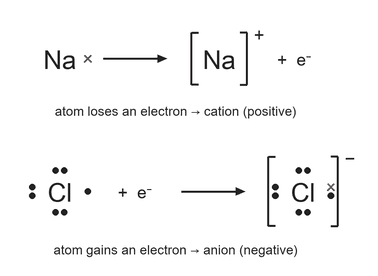
A cation is formed when an atom loses one or more electrons. It is left with more protons than electrons, so it carries a positive charge. Metal atoms usually form cations.
Step 2 — Describe how an anion forms.
An anion is formed when an atom gains one or more electrons. It then has more electrons than protons, so it carries a negative charge. Non-metal atoms usually form anions.
Watch out: Losing a negative electron makes the particle POSITIVE; it is easy to get this the wrong way round.
Therefore, a cation is formed when an atom loses electrons (positive ion), while an anion is formed when an atom gains electrons (negative ion).
- 185 marks
Question 18
Match the Column A with Column B:
Column A Column B (a) Sodium Chloride 1. has two shared pair of electrons (b) Methane 2. has high melting and boiling points (c) Hydrogen chloride gas 3. a greenhouse gas (d) Oxidation reaction 4. has low melting and boiling points (e) Water 5. 6. Solve with AIWritten solution
Solution:
Concept: Each item of Column A is matched with one statement of Column B. Ionic compounds have high melting and boiling points, covalent ones low; count the shared pairs in a molecule; oxidation is the loss of electrons and reduction the gain of electrons.
Step 1 — (a) Match sodium chloride.
Sodium chloride is electrovalent; strong electrostatic forces between its ions give it high melting and boiling points, so (a) matches 2.
Step 2 — (b) Match methane.
Methane traps heat (infrared radiation) in the atmosphere, so it is a greenhouse gas: (b) matches 3. Methane also has low melting and boiling points, but that statement is needed for (c).
Step 3 — (c) Match hydrogen chloride gas.
Hydrogen chloride is a covalent compound made of molecules with weak forces between them, so it has low melting and boiling points: (c) matches 4.
Step 4 — (d) Match oxidation reaction.
In statement 5 zinc loses two electrons, which is oxidation:
So (d) matches 5. Statement 6 shows sulphur gaining two electrons, which is reduction, so it is not used.
Step 5 — (e) Match water.
In water, oxygen shares one pair with each of the two hydrogen atoms, so water has two shared pairs of electrons: (e) matches 1.
Watch out: Statement 5 is printed as 'Zn − 2e⁻ ⟶ Zn²⁺', which says the same thing as Zn → Zn²⁺ + 2e⁻: zinc loses two electrons.
Therefore, (a) → 2, (b) → 3, (c) → 4, (d) → 5, (e) → 1 (statement 6 is not used).
- 191 mark
Question 19
Fill in the blanks with the choices given in the brackets:
(a) Metals are good ............... [oxidizing agents /reducing agents]
Solve with AIWritten solution
Solution:
Concept: Oxidation is the loss of electrons and reduction is the gain of electrons. Electrons lost by one substance are gained by another, so the two always happen together, in a redox reaction. The electron donor is the reducing agent; the electron acceptor is the oxidising agent.
Step 1 — Recall how metal atoms behave.
Metal atoms have 1, 2 or 3 valence electrons, which they lose easily to form positive ions, for example:
Step 2 — See what this does to the other substance.
The electrons lost by the metal are gained by the other substance, so that substance is reduced. A substance that gives electrons and reduces another is a reducing agent.

Step 3 — Fill in the blank.
Since metals give away electrons readily, they are good reducing agents.
Watch out: The metal itself is OXIDISED (it loses electrons), yet it is called a REDUCING agent because of what it does to the other substance.
Therefore, metals are good reducing agents.
- 201 mark
Question 20
Fill in the blanks with the choices given in the brackets:
(b) Non-polar covalent compounds are ............... [good / bad] conductors of heat and electricity.
Solve with AIWritten solution
Solution:
Concept: Electricity is carried by free charged particles: mobile ions in a liquid or solution, or free electrons in a metal. Non-polar covalent compounds have neither.
Step 1 — Look at the particles.
Non-polar covalent compounds such as and are made of neutral molecules. They contain no ions and no free electrons, and they do not ionise even when mixed with water.
Step 2 — Decide about conduction.
With no free charges to carry a current, these compounds do not conduct electricity, and with no free electrons they also conduct heat poorly.
Step 3 — Fill in the blank.
So non-polar covalent compounds are bad conductors.
Therefore, non-polar covalent compounds are bad conductors of heat and electricity.
- 212 marks
Question 21
Draw the electron dot structure for the following:
(a) Ammonium ion
(b) A molecule of nitrogen
[At. No.: N=7, H=1]
Solve with AIWritten solution
Solution:
Concept: The ammonium ion forms when ammonia's lone pair is donated to (a coordinate bond). The nitrogen molecule forms when two nitrogen atoms share three pairs of electrons (a triple covalent bond).
Step 1 — (a) Form the ammonium ion.
In ammonia, nitrogen (2, 5) uses 3 of its 5 valence electrons in N–H bonds and keeps one lone pair. It donates this lone pair to a hydrogen ion:
Step 2 — (a) Draw the ammonium ion.
The donated pair is shown in blue (both electrons from N).
The ion has three covalent N–H bonds and one coordinate bond, no lone pair on nitrogen, and one positive charge.
Step 3 — (b) Draw the nitrogen molecule.
Each nitrogen atom needs 3 more electrons, so each puts 3 electrons into the bond and the atoms share three pairs, giving each atom an octet.
The molecule has a triple covalent bond (N≡N) and one lone pair on each nitrogen atom.
Watch out: Put the ammonium ion inside a square bracket with the + charge outside; the charge belongs to the whole ion.
Therefore, (a) NH₄⁺ has three covalent N–H bonds and one coordinate bond formed from nitrogen's lone pair; (b) N₂ has a triple covalent bond with one lone pair on each N.
- 221 mark
Question 22
Give reason for the following:
(b) Ionic compounds do not conduct electricity in solid state.
Solve with AIWritten solution
Solution:
Concept: An electric current passes through a liquid or a solution only if it contains ions that are free to move. Positive ions (cations) move to the cathode (negative electrode) and negative ions (anions) move to the anode (positive electrode).
Step 1 — Describe the solid.
In the solid state, the ions of an ionic compound are held in fixed positions in the crystal lattice by strong electrostatic forces of attraction. They can only vibrate about these positions.
Step 2 — Link this to conduction.
A current can flow only if charged particles move towards the electrodes. The ions in the solid cannot move, and there are no free electrons, so no current flows.
Step 3 — Compare with the molten state or a solution.
When the compound is melted or dissolved in water, the lattice breaks down and the ions become free to move, so the compound then conducts.
Watch out: The solid DOES contain ions; the reason it does not conduct is that they cannot move.
Therefore, ionic compounds do not conduct electricity in the solid state because their ions are held in fixed positions in the lattice and are not free to move.
- 231 mark
Question 23
In the molecule of water, oxygen atom has:
Solve with AIAnswer
(A) One shared pair of electrons.
(B) Three shared pairs of electrons.
- Correct
(C) Two lone pairs of electrons.
(D) One lone pair of electrons
Answer: (C) Two lone pairs of electrons.
Concept: Oxygen has 6 valence electrons. In water it uses 2 of them to share with the two hydrogen atoms; the other 4 remain as unshared pairs (lone pairs).
Step 1 — Count the shared pairs.
Oxygen (2, 6) shares one electron with each of the two hydrogen atoms, so there are two shared pairs (two O–H bonds).
Step 2 — Count the lone pairs.
Oxygen has 6 valence electrons and has used 2 in bonds, so 6 − 2 = 4 electrons are left unshared, which make two lone pairs.
Watch out: Count shared pairs and lone pairs separately: water has two of EACH.
Why the other options are wrong:
- (A) One shared pair of electrons: oxygen shares one pair with each of the two hydrogen atoms, so it has two shared pairs, not one.
- (B) Three shared pairs of electrons: three shared pairs belong to the nitrogen atom of ammonia; oxygen in water has only two.
- (D) One lone pair of electrons: one lone pair is what the nitrogen atom of ammonia has; oxygen in water has two.
Therefore, the oxygen atom in water has two lone pairs of electrons, option (C).
- 241 mark
Question 24
Match the Column A with Column B:
Column A: (a) Water
Column B:
-
Lithium
-
Iodine
-
Covalent compound
-
Acetic acid
-
Ionic compound
-
Sulphuric acid
Solve with AIWritten solution
Solution:
Concept: Two non-metal atoms bond by sharing electrons, and a substance made in this way is a covalent compound.
Step 1 — Decide how water is bonded.
Water is made of oxygen and hydrogen, which are both non-metals. Oxygen shares one electron pair with each of the two hydrogen atoms (polar covalent bonds).
Step 2 — Choose from Column B.
A compound formed by sharing electrons is a covalent compound, which is statement 3. Lithium and iodine are elements, acetic and sulphuric acid are other compounds, and 'ionic compound' needs a transfer of electrons, so none of them fits water.
Therefore, (a) Water matches 3. Covalent compound.
-
- 251 mark
Question 25
Match the Column A with Column B:
Column A: (d) Calcium oxide
Column B:
-
Lithium
-
Iodine
-
Covalent compound
-
Acetic acid
-
Ionic compound
-
Sulphuric acid
Solve with AIWritten solution
Solution:
Concept: A metal atom transfers electrons to a non-metal atom; the ions formed are held by electrostatic forces, and the substance is an ionic (electrovalent) compound.
Step 1 — Decide how calcium oxide is bonded.
Calcium (2, 8, 8, 2) is a metal and transfers its two valence electrons to oxygen (2, 6), a non-metal, forming and ions.
Step 2 — Choose from Column B.
A compound made of ions formed by electron transfer is an ionic compound, which is statement 5.
Therefore, (d) Calcium oxide matches 5. Ionic compound.
-
- 262 marks
Question 26
Draw the electron dot structure of:
(a) Methane molecule
(b) Nitrogen molecule
[Atomic number: N = 7, C = 6, H = 1]
Solve with AIWritten solution
Solution:
Concept: A covalent bond forms when two atoms (usually of non-metals) share one or more pairs of electrons, each atom putting the same number of electrons into the shared pair(s). Each atom counts the shared electrons in its own outer shell, and so reaches a noble gas configuration. Dots show the electrons of one atom and crosses those of the other.
Step 1 — (a) Work out the sharing in methane.
Carbon (2, 4) has 4 valence electrons and needs 4 more; each hydrogen needs 1. So carbon shares one electron with each of four hydrogen atoms, forming four single covalent bonds.
Carbon gets an octet (4 + 4 = 8 electrons) and each hydrogen a duplet.
Step 2 — (b) Work out the sharing in the nitrogen molecule.
Each nitrogen (2, 5) has 5 valence electrons and needs 3 more, so each puts 3 electrons into the bond: three shared pairs, a triple covalent bond, with one lone pair left on each nitrogen.
Watch out: Check each atom: in CH₄ carbon must show 8 electrons and every H 2; in N₂ each N must show 8.
Therefore, (a) methane has four C–H single covalent bonds; (b) the nitrogen molecule has a triple covalent bond (N≡N) with one lone pair on each nitrogen.
- 272 marks
Question 27
Give reasons for the following:
(a) Inert gases do not form ions.
(b) Covalent compounds have a low melting and boiling point.
Solve with AIWritten solution
Solution:
Concept: Atoms of the noble gases (helium, neon, argon …) are stable and do not combine, because their outermost shell is complete: 8 electrons (an octet), or 2 electrons (a duplet) for helium. Every other atom tends to reach the electronic configuration of its nearest noble gas by losing, gaining or sharing electrons, and this is why atoms form chemical bonds. Electrovalent compounds are made of ions held by strong electrostatic forces in a crystal lattice; covalent compounds are made of molecules, and the forces between molecules are weak. Almost every difference in their properties (state, melting and boiling points, solubility, conductivity) follows from this.
Step 1 — (a) Look at the outer shell of an inert gas.
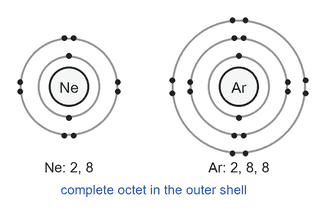
The inert (noble) gases already have a complete outermost shell: neon 2, 8, argon 2, 8, 8 (an octet), and helium 2 (a duplet).
Step 2 — (a) Explain why no ions form.
An atom forms an ion only by losing or gaining electrons to reach a stable configuration. An inert gas atom is already stable, so it has no tendency to lose or gain electrons, and therefore it does not form ions.
Step 3 — (b) Look at the particles in a covalent compound.
A covalent compound is made of separate molecules. The atoms inside each molecule are held by strong covalent bonds, but the forces of attraction between the molecules are weak.
Step 4 — (b) Explain the low melting and boiling points.
Melting and boiling only need the molecules to be separated from one another; the covalent bonds inside them are not broken. Because the forces between the molecules are weak, only a little heat energy is needed, so the compound melts and boils at low temperatures.
Watch out: Melting a covalent compound does NOT break its covalent bonds; it only overcomes the weak forces between the molecules.
Therefore, (a) inert gases do not form ions because they already have a stable octet (helium a duplet) and do not need to lose or gain electrons; (b) covalent compounds have low melting and boiling points because the forces between their molecules are weak.
- 281 mark
Question 28
Fill in the blanks by choosing the correct answer from the bracket:
(a) Carbon tetrachloride is a ............... [polar / non-polar] covalent molecule.
Solve with AIWritten solution
Solution:
Concept: Electronegativity is the tendency of an atom to attract a shared pair of electrons towards itself. If the two bonded atoms have equal electronegativity, the pair is shared equally and the bond is non-polar; if one is more electronegative, it pulls the pair closer, gets a partial negative charge (δ−) and the other a partial positive charge (δ+), and the bond is polar. A molecule with polar bonds can still be non-polar overall if the bonds are arranged symmetrically, so that their pulls cancel.
Step 1 — Look at each C–Cl bond.
Chlorine (electronegativity 3.0) attracts the shared pair a little more than carbon (2.5), so each C–Cl bond on its own is slightly polar.
Step 2 — Look at the shape of the whole molecule.
The four chlorine atoms are arranged symmetrically round the carbon atom (at the corners of a regular tetrahedron), so the four equal pulls cancel out. The molecule has no positive end and no negative end.
Step 3 — Fill in the blank.
With no overall partial charges, carbon tetrachloride is a non-polar covalent molecule. This is also why it does not mix with water and does not conduct electricity.
Watch out: A molecule with polar bonds is not automatically polar; check whether its shape makes the pulls cancel.
Therefore, carbon tetrachloride is a non-polar covalent molecule.
- 293 marks
Question 29
The following table shows the electronic configuration of the atoms A, B, C and D.
Element A B C D Electronic configuration 2, 8, 8, 2 2, 6 2, 8, 7 2, 4 (a) Write the formula of the compound formed between:
-
A and B
-
D and C
(b) Which of the above elements will exhibit catenation?
Solve with AIWritten solution
Solution:
Concept: The number of valence electrons tells us how an atom bonds: 1 to 3 means a metal that loses electrons; 5 to 7 a non-metal that gains (or shares) electrons; 4 means the atom shares electrons. The formula is found by making the electrons lost equal to the electrons gained, or by matching each shared electron with a partner.
Step 1 — Identify each element from its configuration.
We add up the electrons to get each atomic number and read the valence electrons:
Element Configuration Atomic number Valence electrons Element is Behaviour A 2, 8, 8, 2 20 2 calcium metal: loses 2 B 2, 6 8 6 oxygen non-metal: gains 2 C 2, 8, 7 17 7 chlorine non-metal: needs 1 D 2, 4 6 4 carbon shares 4 Step 2 — (a) 1. Formula of the compound of A and B.
A loses 2 electrons and B gains 2, so one A gives both its electrons to one B. The ions and combine 1 : 1, so the formula is AB (an ionic compound, like calcium oxide, CaO).
Step 3 — (a) 2. Formula of the compound of D and C.
D needs 4 electrons and each C needs 1, so D shares one pair with each of four C atoms. The formula is DC₄ (a covalent compound, like carbon tetrachloride, CCl₄).

Step 4 — (b) Decide which element shows catenation.
Catenation is the ability of atoms of the same element to join to one another in long chains or rings. Carbon (D) does this best, because it has 4 valence electrons and forms strong C–C covalent bonds, so D shows catenation.
Watch out: In (a) 2 the question names D first; the formula is still DC₄, with one D and four C atoms.
Therefore, (a) 1. A and B form AB; 2. D and C form DC₄; (b) element D (carbon) exhibits catenation.
-
- 301 mark
Question 30
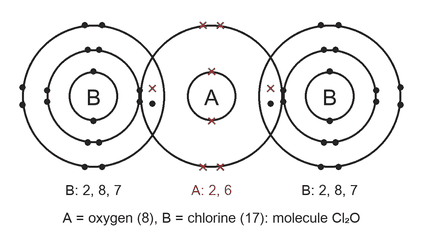
The diagram given below shows the bonding in the covalent molecule .

Which option represents the correct electronic configuration of atoms A and B before combining together to form the above molecule?
A B 1 2, 4 2, 8, 6 2 2, 4 2, 8, 7 3 2, 8 2, 8, 8 4 2, 6 2, 8, 7 Solve with AIAnswer
(A) 1
(B) 2
(C) 3
- Correct
(D) 4
Answer: (D) 4
Concept: In a dot and cross diagram every electron of an atom is drawn on its shells. Each shared pair between two atoms holds one electron from each, so to get an atom's configuration before bonding we count its own symbols (crosses for A, dots for B), shell by shell.
Step 1 — Count the electrons of atom A.
Atom A's electrons are the crosses. Its inner shell has 2. Its outer shell has a pair at the top, a pair at the bottom and one cross in each of the two shared pairs, that is 2 + 2 + 1 + 1 = 6. So A is 2, 6 (oxygen, atomic number 8).
Step 2 — Count the electrons of each atom B.
Atom B's electrons are the dots. Its first shell has 2 and its second shell 8. Its outer shell has three pairs of its own plus one dot in the shared pair, that is 6 + 1 = 7. So B is 2, 8, 7 (chlorine, atomic number 17).
Step 3 — Check the bonding makes sense.
Oxygen needs 2 electrons and each chlorine needs 1, so oxygen shares one pair with each of two chlorine atoms and every atom reaches an octet. The molecule is , which fits the formula AB₂. Row 4 gives A = 2, 6 and B = 2, 8, 7.
Watch out: The shared pairs belong to both atoms AFTER bonding; before bonding each atom had only its own electron of each pair, so count one, not two, for each shared pair.
Why the other options are wrong:
- (A) 1: row 1 gives A as 2, 4 and B as 2, 8, 6; an atom with 4 valence electrons would share four pairs and one with 6 would share two, but the figure shows A sharing two pairs and each B one pair.
- (B) 2: row 2 gives A as 2, 4; an atom with 4 valence electrons shares four pairs, but A in the figure shares only two.
- (C) 3: row 3 gives 2, 8 and 2, 8, 8, which are the configurations of the noble gases neon and argon; such atoms already have an octet and do not share electrons.
Therefore, before combining, A is 2, 6 and B is 2, 8, 7, which is row 4, option (D).
- 311 mark
Question 31
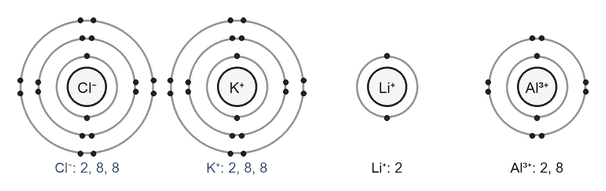
Given below are four ions:
, , ,
Identify the pair of ions which have the same electronic configuration. [Atomic number: Cl = 17, Li = 3, Al = 13, K = 19]
Solve with AIAnswer
(A) &
(B) &
- Correct
(C) &
(D) &
Answer: (C) &
Concept: To find the configuration of an ion, write the configuration of its atom, then add electrons for a negative charge or remove electrons for a positive charge (one electron per unit of charge).
Step 1 — Work out the chloride ion.
Chlorine (17) is 2, 8, 7. The ion has gained 1 electron, so it is 2, 8, 8 (18 electrons).
Step 2 — Work out the potassium ion.
Potassium (19) is 2, 8, 8, 1. The ion has lost 1 electron, so it is 2, 8, 8 (18 electrons).
Step 3 — Work out the other two ions.
Lithium (3) is 2, 1, so is 2. Aluminium (13) is 2, 8, 3, so is 2, 8.
Step 4 — Compare.
Only and have the same configuration, 2, 8, 8, which is that of argon.
Watch out: A positive ion has FEWER electrons than its atom and a negative ion MORE; do not add electrons for a + charge.
Why the other options are wrong:
- (A) & : is 2, 8, 8 but is 2, so they differ.
- (B) & : is 2, 8 but is 2, 8, 8, so they differ.
- (D) & : is 2 but is 2, 8, 8, so they differ.
Therefore, the pair with the same electronic configuration is Cl⁻ and K⁺, option (C).
- 321 mark
Question 32
State the terms for the following:
The type of covalent bond in which electrons are shared unequally between the combining atoms.
Solve with AIWritten solution
Solution:
Concept: Electronegativity is the tendency of an atom to attract a shared pair of electrons towards itself. If the two bonded atoms have equal electronegativity, the pair is shared equally and the bond is non-polar; if one is more electronegative, it pulls the pair closer, gets a partial negative charge (δ−) and the other a partial positive charge (δ+), and the bond is polar.
Step 1 — Decide when sharing is unequal.
Sharing is unequal when the two bonded atoms are of different elements with different electronegativities: the more electronegative atom pulls the shared pair closer to itself.
Step 2 — See what this does to the bond.
The more electronegative atom gets a partial negative charge (δ−) and the other a partial positive charge (δ+). In hydrogen chloride, for example, chlorine (3.0) pulls the pair away from hydrogen (2.1), giving H(δ+)–Cl(δ−).
Step 3 — Name the bond.
A covalent bond with such partial charges is called a polar covalent bond.
Therefore, the covalent bond in which electrons are shared unequally is a polar covalent bond.
- 333 marks
Question 33
Draw the dot and cross structure of the following:
(a) An ionic compound formed when Mg reacts with the dilute .
(b) A covalent compound formed when reacts with .
(c) The positive ion produced when ammonia gas is dissolved in water. [Atomic number: Mg = 12, Cl = 17, H = 1, N = 7]
Solve with AIWritten solution
Solution:
Concept: First write each reaction to find the product, then draw it. Magnesium chloride is ionic (electron transfer), hydrogen chloride is covalent (sharing), and ammonia in water gives the ammonium ion (coordinate bond). Dots and crosses show which atom each electron came from.
Step 1 — (a) Find the ionic compound.
Magnesium reacts with dilute hydrochloric acid to give magnesium chloride and hydrogen:
Step 2 — (a) Draw magnesium chloride.
Magnesium (2, 8, 2) gives one electron to each of two chlorine atoms (2, 8, 7), forming (2, 8) and two ions (2, 8, 8), each with a stable octet.
Step 3 — (b) Find and draw the covalent compound.
Hydrogen and chlorine combine to form hydrogen chloride:
In HCl, hydrogen and chlorine share one pair (one electron from each), a polar single covalent bond; chlorine keeps three lone pairs and hydrogen gets a duplet (left part of the figure below).
Step 4 — (c) Find the positive ion.
Ammonia reacts with water; the lone pair on nitrogen accepts a hydrogen ion from a water molecule:
The positive ion is the ammonium ion, .
Step 5 — (c) Draw the ammonium ion.
Nitrogen donates its lone pair to the hydrogen ion, so the ion has three covalent N–H bonds and one coordinate bond (blue pair), with a single + charge outside the bracket.

Watch out: The positive ion in (c) is NH₄⁺, not H₃O⁺: ammonia takes the H⁺ from water, leaving OH⁻ behind.
Therefore, (a) MgCl₂: Mg²⁺ with two Cl⁻ ions; (b) HCl: one shared pair between H and Cl, three lone pairs on Cl; (c) NH₄⁺: three covalent N–H bonds and one coordinate bond.
- 341 mark
Question 34
Define Co-ordinate bond.
Solve with AIWritten solution
Solution:
Concept: In an ordinary covalent bond each atom gives one electron to the shared pair; in a coordinate bond one atom gives both electrons.
Step 1 — Define the bond.
A co-ordinate (dative) bond is a bond formed between two atoms by the sharing of a pair of electrons that is provided entirely by one of the combining atoms but is shared by both.
Step 2 — Name the two partners.
The atom that gives the pair must have a lone pair; it is the donor. The atom or ion that receives the pair, such as , is the acceptor. The bond is shown by an arrow from the donor to the acceptor.
Step 3 — Give an example.
In the ammonium ion, the nitrogen of ammonia donates its lone pair to a hydrogen ion:
Watch out: Once formed, a coordinate bond is just like any other covalent bond; only the ORIGIN of its electrons differs.
Therefore, a co-ordinate bond is a covalent bond in which the shared pair of electrons is provided by only one of the two combining atoms, e.g. the N→H bond in NH₄⁺.
- 351 mark
Question 35
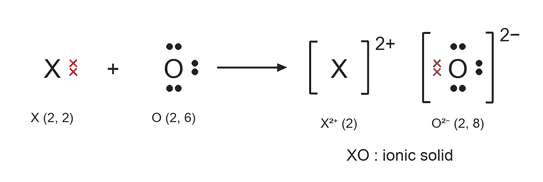
An element X has an electronic configuration 2, 2. The compound formed when X combines with oxygen is most likely to be:
Solve with AIAnswer
(A) a compound with a low melting point.
(B) a gas that dissolves in water to form an electrolyte.
(C) a good conductor in both solid and molten state.
- Correct
(D) an ionic solid.
Answer: (D) an ionic solid.
Concept: An atom with 1, 2 or 3 valence electrons is a metal; it gives these electrons to a non-metal such as oxygen. The ions formed are held in a crystal lattice by strong electrostatic forces, so the compound is an ionic solid with a high melting point that conducts only when molten or dissolved.
Step 1 — Identify X.
X has the configuration 2, 2, so its atomic number is 4 (beryllium, group 2). It has 2 valence electrons and loses them to form (configuration 2).
Step 2 — See what oxygen does.
Oxygen (2, 6) gains the 2 electrons to form (2, 8).
Step 3 — Describe the compound.
The ions are held in a crystal lattice by strong electrostatic forces, so the oxide XO is an ionic solid with a high melting point.
Watch out: Real beryllium oxide has some covalent character, but it is still a hard solid with a very high melting point that does not conduct when solid; of the four options only (D) describes it.
Why the other options are wrong:
- (A) a compound with a low melting point: a low melting point belongs to covalent compounds; an ionic oxide needs a lot of energy to break its lattice, so its melting point is high.
- (B) a gas that dissolves in water to form an electrolyte: the oxide of a metal is a solid lattice, not a gas made of molecules.
- (C) a good conductor in both solid and molten state: an ionic solid does not conduct in the solid state, because its ions are held in fixed positions; it conducts only when molten.
Therefore, the oxide of X is most likely an ionic solid, option (D).
- 361 mark
Question 36
State the terms for the following:
A type of covalent bond in which electrons are shared equally between the combining atoms.
Solve with AIWritten solution
Solution:
Concept: Electronegativity is the tendency of an atom to attract a shared pair of electrons towards itself. If the two bonded atoms have equal electronegativity, the pair is shared equally and the bond is non-polar; if one is more electronegative, it pulls the pair closer, gets a partial negative charge (δ−) and the other a partial positive charge (δ+), and the bond is polar.
Step 1 — Decide when sharing is equal.
Electrons are shared equally when both atoms pull the shared pair equally, which happens when the two atoms are of the same element (equal electronegativity).
Step 2 — See what this does to the bond.
The shared pair lies midway between the two atoms, so no partial charges develop, as in , and .
Step 3 — Name the bond.
A covalent bond with equal sharing is a non-polar covalent bond.
Therefore, the covalent bond in which electrons are shared equally is a non-polar covalent bond.
- 371 mark
Question 37
State the terms for the following:
The substance which oxidises the other substance and itself gets reduced.
Solve with AIWritten solution
Solution:
Concept: Oxidation is the loss of electrons and reduction is the gain of electrons. Electrons lost by one substance are gained by another, so the two always happen together, in a redox reaction. The electron donor is the reducing agent; the electron acceptor is the oxidising agent.
Step 1 — Read what the substance does.
The substance oxidises the other substance, that is, it takes electrons away from it, and in doing so it gains those electrons and is itself reduced.
Step 2 — Check with an example.
In the reaction below, the lead ion takes two electrons from zinc. Zinc is oxidised, and , which accepts the electrons, is reduced:
Step 3 — Name the substance.
An electron acceptor that oxidises another substance is called an oxidising agent.
Watch out: Do not confuse it with the reducing agent, which is the substance that gets oxidised.
Therefore, the substance which oxidises the other substance and itself gets reduced is an oxidising agent.
- 382 marks
Question 38
In the given equation
(a) ............... undergoes oxidation.
(b) ............... undergoes reduction.
Solve with AIWritten solution
Solution:
Concept: Oxidation is the loss of electrons and reduction is the gain of electrons. Electrons lost by one substance are gained by another, so the two always happen together, in a redox reaction. The electron donor is the reducing agent; the electron acceptor is the oxidising agent. Splitting the reaction into two half-reactions shows which particle loses and which gains electrons.
Step 1 — Write what happens to zinc.
A zinc atom becomes a zinc ion with a 2+ charge, so it must have lost two electrons:
Loss of electrons is oxidation, so zinc is oxidised.
Step 2 — Write what happens to the lead ion.
A lead ion with a 2+ charge becomes a neutral lead atom, so it must have gained two electrons:
Gain of electrons is reduction, so the lead ion is reduced.
Step 3 — Name the agents.
Zinc gives the electrons, so it is the reducing agent; the lead ion takes them, so it is the oxidising agent.
Watch out: The lead ion is reduced even though its name has no 'gain' in it: its charge falls from 2+ to 0 because it gains two electrons.
Therefore, (a) zinc (Zn) undergoes oxidation; (b) the lead ion (Pb²⁺) undergoes reduction.
- 393 marks
Question 39
Draw the dot and cross structure of the following:
(a) Hydronium ion
(b) Oxygen molecule
(c) Calcium oxide
[Atomic number: H = 1, O = 8, Ca = 20]
Solve with AIWritten solution
Solution:
Concept: The hydronium ion forms when a lone pair of water is donated to (a coordinate bond); the oxygen molecule forms when two oxygen atoms share two pairs (a double covalent bond); calcium oxide forms by the transfer of two electrons (an electrovalent bond). Dots (•) show the electrons of one atom and crosses (×) those of the other.
Step 1 — (a) Form the hydronium ion.
In water, oxygen keeps two lone pairs. It donates one of them to a hydrogen ion:
Step 2 — (a) Draw the hydronium ion.
The donated pair (blue) is the coordinate bond.
The ion has two covalent O–H bonds and one coordinate bond, one lone pair is left on oxygen, and the ion has a single + charge.
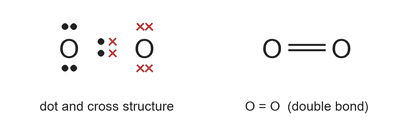
Step 3 — (b) Draw the oxygen molecule.
Each oxygen atom (2, 6) needs 2 electrons, so each puts 2 electrons into the bond and the atoms share two pairs: a double covalent bond (O=O). Each atom keeps two lone pairs, so each has 4 shared + 4 unshared = 8 electrons.
Step 4 — (c) Draw calcium oxide.
Calcium (2, 8, 8, 2) transfers its two valence electrons to oxygen:
This gives (2, 8, 8) and (2, 8), held by electrostatic attraction.
Watch out: O₂ has a DOUBLE bond (two shared pairs); drawing a single shared pair leaves each oxygen with only 7 electrons.
Therefore, (a) H₃O⁺: two covalent O–H bonds, one coordinate bond and one lone pair on O; (b) O₂: two shared pairs (O=O) and two lone pairs on each O; (c) CaO: Ca²⁺ and O²⁻ formed by the transfer of two electrons.
- 401 mark
Question 40
Which of the following element pairs will form an ionic bond?
Pair P Elements of Group 1 & Group 2 Q Elements of Group 14 & Group 16 R Elements of Group 2 & Group 17 S Elements of Group 15 & Group 18 Solve with AIAnswer
(A) P
(B) Q
- Correct
(C) R
(D) S
Answer: (C) R
Concept: An ionic bond forms between a metal that loses electrons easily and a non-metal that gains them. Groups 1 and 2 are metals (except hydrogen), groups 16 and 17 are reactive non-metals, and group 18 is the noble gases.
Step 1 — Look at group 2.
Group 2 elements, such as magnesium (2, 8, 2), have 2 valence electrons and are metals that lose them easily.
Step 2 — Look at group 17.
Group 17 elements, such as chlorine (2, 8, 7), have 7 valence electrons and are non-metals that gain 1 electron easily.
Step 3 — Combine them.
One group 2 atom gives one electron to each of two group 17 atoms, forming an ionic compound such as magnesium chloride, . So pair R forms an ionic bond.
Watch out: An ionic bond needs one partner that LOSES and one that GAINS electrons; two metals or two non-metals cannot form one.
Why the other options are wrong:
- (A) P: groups 1 and 2 are both metals (apart from hydrogen), and both lose electrons, so neither can accept electrons from the other.
- (B) Q: group 14 and group 16 elements, such as carbon and oxygen, are non-metals that share electrons and form covalent bonds (as in CO₂).
- (D) S: group 18 elements are noble gases with complete octets; they do not lose or gain electrons, so they form no ions.
Therefore, the pair that forms an ionic bond is R (group 2 with group 17), option (C).
- 411 mark
Question 41
An atom of X forms an ion according to the equation .
The atomic number of the atom X is:
Solve with AIAnswer
(A) 16
(B) 10
- Correct
(C) 12
(D) 14
Answer: (C) 12
Concept: An atom that forms a 2+ ion has lost two electrons, so it must have 2 valence electrons, which it gives away to leave a stable octet.
Step 1 — Write the configurations of the choices.
We fill the shells 2, 8, 8 … for each atomic number: 16 → 2, 8, 6; 10 → 2, 8; 12 → 2, 8, 2; 14 → 2, 8, 4.
Step 2 — Find the atom with 2 valence electrons.
Only atomic number 12 (magnesium) has 2 electrons in its outermost shell. It loses them and is left with 2, 8, a stable octet:
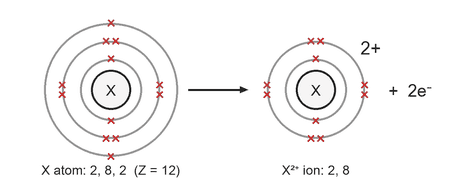
Watch out: The printed charge 'X⁺²' means the same as X²⁺ (the usual way of writing it): two electrons lost.
Why the other options are wrong:
- (A) 16: atomic number 16 (sulphur) is 2, 8, 6; it gains 2 electrons and forms a 2− ion, not a 2+ ion.
- (B) 10: atomic number 10 (neon) is 2, 8, a noble gas with a full octet; it forms no ion.
- (D) 14: atomic number 14 (silicon) is 2, 8, 4; it shares its 4 electrons in covalent bonds instead of forming a 2+ ion.
Therefore, the atomic number of X is 12, option (C).
- 421 mark
Question 42
The compound that has the highest melting point amongst the following is:
Solve with AIAnswer
(A) Methane
- Correct
(B) Sodium chloride
(C) Ammonia
(D) Ethanol
Answer: (B) Sodium chloride
Concept: Electrovalent compounds are made of ions held by strong electrostatic forces in a crystal lattice; covalent compounds are made of molecules, and the forces between molecules are weak. Almost every difference in their properties (state, melting and boiling points, solubility, conductivity) follows from this. So electrovalent compounds have high melting points and covalent compounds low ones.
Step 1 — Classify the four compounds.
Sodium chloride is made from a metal and a non-metal by electron transfer, so it is electrovalent. Methane, ammonia and ethanol are made only of non-metals by sharing, so they are covalent.
Step 2 — Compare the forces.
In sodium chloride the and ions are held by strong electrostatic forces throughout the lattice, so it is a solid that melts only at about 801 °C. The covalent compounds have weak forces between their molecules and melt far below 0 °C (methane about −182 °C, ethanol about −114 °C, ammonia about −78 °C).
Watch out: Ethanol is a liquid at room temperature, not a solid, so its melting point is below room temperature.
Why the other options are wrong:
- (A) Methane: methane is a covalent gas with very weak forces between its molecules, so its melting point is very low.
- (C) Ammonia: ammonia is a covalent gas, so its melting point is low.
- (D) Ethanol: ethanol is a covalent liquid at room temperature, so its melting point is far below that of sodium chloride.
Therefore, the compound with the highest melting point is sodium chloride, option (B).
- 431 mark
Question 43
Identify the following terms / compounds:
A pair of electrons present in an atom which is not shared with any other atom during bond formation.
Solve with AIWritten solution
Solution:
Concept: During bond formation an atom uses some of its valence electrons in shared pairs. Any valence electrons left unshared stay on the atom in pairs.
Step 1 — Read the statement.
The statement describes a pair of electrons that belongs to one atom and is not shared with any other atom.
Step 2 — Check with an example.
In ammonia, nitrogen has 5 valence electrons and uses 3 in its N–H bonds, so one pair is left unshared. In water, oxygen uses 2 of its 6, so two pairs are left.
Step 3 — Name the term.
Such an unshared pair is called a lone pair of electrons.
Therefore, the term is a lone pair of electrons.
- 441 mark
Question 44
Complete the following sentences by choosing the correct option from the brackets:
............... is a polar covalent compound. [ / ]
Solve with AIWritten solution
Solution:
Concept: Electronegativity is the tendency of an atom to attract a shared pair of electrons towards itself. If the two bonded atoms have equal electronegativity, the pair is shared equally and the bond is non-polar; if one is more electronegative, it pulls the pair closer, gets a partial negative charge (δ−) and the other a partial positive charge (δ+), and the bond is polar. A molecule is polar overall only if these pulls do not cancel out.
Step 1 — Look at HCl.
Chlorine (electronegativity 3.0) attracts the shared pair more strongly than hydrogen (2.1), so the pair is pulled towards chlorine: H becomes δ+ and Cl δ−. With only one bond there is nothing to cancel this, so HCl is polar.
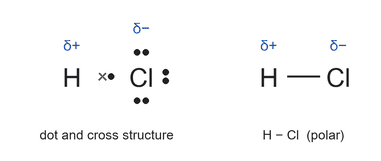
Step 2 — Look at CCl₄.
Each C–Cl bond is slightly polar, but the four bonds are arranged symmetrically round the carbon atom, so their pulls cancel and the CCl₄ molecule is non-polar.
Step 3 — Choose.
Of the two choices, only is a polar covalent compound.
Therefore, HCl is a polar covalent compound.
- 453 marks
Question 45
Element A belongs to group 15 and period 2 of the Periodic Table.
(a) Identify the element A.
(b) Write the formula of the compound formed when element A combines with hydrogen.
(c) Draw the dot (•) and cross (×) structure of the compound formed in (b) above.
Solve with AIWritten solution
Solution:
Concept: The period number of an element is its number of shells, and for groups 13 to 18 the number of valence electrons is the group number minus 10. A non-metal atom then shares as many electrons as it needs to complete its octet.
Step 1 — (a) Identify element A.
Period 2 means the atom has two shells, and group 15 means it has 15 − 10 = 5 valence electrons. So its configuration is 2, 5, which adds up to atomic number 7: element A is nitrogen (N).
Step 2 — (b) Write the formula of the hydride.
Nitrogen has 5 valence electrons and needs 3 more for an octet; each hydrogen needs 1 more for a duplet. So one nitrogen atom shares one pair with each of three hydrogen atoms, and the formula is (ammonia), that is AH₃.
Step 3 — (c) Draw the dot and cross structure.
Nitrogen's electrons are shown as dots and hydrogen's as crosses. Each N–H bond is one dot and one cross.
There are three single covalent N–H bonds; nitrogen gets an octet with one lone pair, and each hydrogen gets a duplet.
Watch out: Do not forget the lone pair on nitrogen; without it nitrogen shows only 6 electrons.
Therefore, (a) A is nitrogen; (b) the compound is NH₃ (ammonia); (c) NH₃ has three N–H shared pairs and one lone pair on nitrogen.
- 461 mark
Question 46
A polar covalent compound with two lone pairs of electrons is:
Solve with AIAnswer
(A) ammonia
- Correct
(B) water
(C) chlorine
(D) oxygen
Answer: (B) water
Concept: Electronegativity is the tendency of an atom to attract a shared pair of electrons towards itself. If the two bonded atoms have equal electronegativity, the pair is shared equally and the bond is non-polar; if one is more electronegative, it pulls the pair closer, gets a partial negative charge (δ−) and the other a partial positive charge (δ+), and the bond is polar. A lone pair is a pair of valence electrons not used in bonding; count them on the central atom.
Step 1 — Count the lone pairs in water.
Oxygen (2, 6) uses 2 of its 6 valence electrons in its two O–H bonds and keeps 4 unshared, which are two lone pairs.
Step 2 — Check that water is a polar covalent compound.
Water is a compound of two elements, and oxygen (3.5) pulls each shared pair away from hydrogen (2.1), so its bonds are polar covalent.
Watch out: The question asks for a COMPOUND; chlorine and oxygen are elements, so they are out whatever their lone pairs.
Why the other options are wrong:
- (A) ammonia: ammonia is a polar covalent compound, but its nitrogen atom has only one lone pair.
- (C) chlorine: chlorine is an element, not a compound, and its Cl–Cl bond is non-polar (equal sharing).
- (D) oxygen: oxygen is an element, not a compound, and its O=O bond is non-polar.
Therefore, the polar covalent compound with two lone pairs of electrons is water, option (B).
- 471 mark
Question 47
The table below shows the atomic numbers of elements W, X, Y and Z.
Element Atomic Number W 4 X 13 Y 7 Z 10 Which of the above elements will combine to form an electrovalent compound?
Solve with AIAnswer
(A) Y and Z
(B) C and Z
- Correct
(C) X and Y
(D) X and W
Answer: (C) X and Y
Concept: An electrovalent compound forms between a metal that loses electrons and a non-metal that gains them. Write each configuration first to see which elements are metals and which are non-metals.
Step 1 — Write the configurations.
W (4) is 2, 2, a metal (2 valence electrons). X (13) is 2, 8, 3, a metal (3 valence electrons). Y (7) is 2, 5, a non-metal (5 valence electrons). Z (10) is 2, 8, a noble gas.
Step 2 — Find the metal and non-metal pair.
X loses 3 electrons and Y gains 3, so X and Y can form ions:
Both ions then have a stable octet (2, 8), and the charges 3+ and 3− cancel, so X and Y form the electrovalent compound XY.
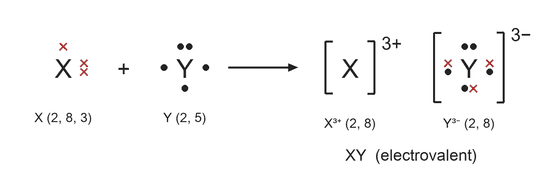
Watch out: In this simple model a metal and a non-metal give an electrovalent compound; real aluminium nitride (X = Al, Y = N) has a lot of covalent character, but X and Y is still the only metal–non-metal pair offered.
Why the other options are wrong:
- (A) Y and Z: Z is a noble gas with a complete octet, so it does not combine with Y.
- (B) C and Z: there is no element C in the table, so option (B) cannot be right as printed; if W and Z was meant, Z is still a noble gas and forms no compound.
- (D) X and W: X and W are both metals; both lose electrons, so neither can accept electrons from the other.
Therefore, the elements that combine to form an electrovalent compound are X and Y, option (C).
- 481 mark
Question 48
Sodium is in Group I of the Periodic Table and chlorine is in Group VII. Which statement correctly describes what happens when sodium bonds ionically with chlorine?
Solve with AIAnswer
(A) Sodium atom gains an electron to form and chlorine atom loses an electron to form
(B) Sodium atom gains an electron to form and chlorine atom loses an electron to form
(C) Sodium atom loses an electron to form and chlorine atom gains an electron to form
- Correct
(D) Sodium atom loses an electron to form and chlorine atom gains an electron to form
Answer: (D) Sodium atom loses an electron to form and chlorine atom gains an electron to form
Concept: Sodium (group I) has 1 valence electron, which it loses; chlorine (group VII) has 7 valence electrons and gains 1. Losing a negative electron leaves a positive ion; gaining one gives a negative ion.
Step 1 — See what happens to sodium.
Sodium (2, 8, 1) loses its single valence electron, so it is left with one more proton than electrons, a positive ion:
Step 2 — See what happens to chlorine.
Chlorine (2, 8, 7) gains that electron, so it has one more electron than protons, a negative ion:
Step 3 — Match with the options.
Only option (D) has both the direction of transfer (sodium loses, chlorine gains) and both charges (Na⁺, Cl⁻) right.
Watch out: Check BOTH parts of each option: the direction of the electron and the sign of the charge.
Why the other options are wrong:
- (A) Sodium atom gains an electron to form and chlorine atom loses an electron to form : the transfer is the wrong way round (sodium does not gain an electron and chlorine does not lose one), and the charges Na⁻ and Cl⁺ are wrong too.
- (B) Sodium atom gains an electron to form and chlorine atom loses an electron to form : sodium does not gain an electron; and gaining an electron would give a negative ion, so 'gains … to form Na⁺' cannot happen.
- (C) Sodium atom loses an electron to form and chlorine atom gains an electron to form : the direction is right, but the charges are wrong: losing an electron gives Na⁺, not Na⁻, and gaining one gives Cl⁻, not Cl⁺.
Therefore, sodium loses an electron to form Na⁺ and chlorine gains an electron to form Cl⁻, option (D).
- 491 mark
Question 49
Hydrogen chloride is soluble in water because it is a / an:
Solve with AIAnswer
(A) base
(B) ionic compound
- Correct
(C) polar covalent compound
(D) non-polar covalent compound
Answer: (C) polar covalent compound
Concept: "Like dissolves like": water is a polar molecule, so it dissolves polar compounds readily, while non-polar compounds hardly dissolve in it.
Step 1 — Look at the H–Cl bond.
Chlorine (3.0) pulls the shared pair towards itself more strongly than hydrogen (2.1) does, so H becomes δ+ and Cl δ−: hydrogen chloride is a polar covalent compound.
Step 2 — Explain the solubility.
The partial charges on HCl molecules are attracted by the polar water molecules, so hydrogen chloride dissolves readily (it then ionises in water, giving hydronium and chloride ions).
Watch out: HCl gas is covalent; its solution contains ions only because it reacts with water.
Why the other options are wrong:
- (A) base: hydrogen chloride is not a base; its solution in water is an acid (hydrochloric acid).
- (B) ionic compound: hydrogen chloride is a covalent gas made of molecules, not an ionic compound.
- (D) non-polar covalent compound: hydrogen chloride is polar, not non-polar; non-polar compounds such as CCl₄ hardly dissolve in water.
Therefore, hydrogen chloride is soluble in water because it is a polar covalent compound, option (C).
- 505 marks
Question 50
Match Column 1 with Column 2 without repeating the options from Column 2.
Column 1 Column 2 (a) Ammonia 1. triple covalent bond (b) Carbon tetrachloride 2. double covalent bond (c) Sodium chloride 3. three single covalent bonds (d) Nitrogen 4. electrovalent bond (e) Oxygen 5. non-polar covalent bond Solve with AIWritten solution
Solution:
Concept: Count the shared pairs in each molecule and decide whether electrons are shared or transferred. Each option of Column 2 is used only once.
Step 1 — (a) Match ammonia.
Nitrogen shares one pair with each of three hydrogen atoms, so ammonia has three single covalent bonds: (a) → 3.
Step 2 — (b) Match carbon tetrachloride.
Its four C–Cl bonds are arranged symmetrically round carbon, so the molecule is non-polar: (b) → 5, non-polar covalent bond.
Step 3 — (c) Match sodium chloride.
Sodium transfers one electron to chlorine, forming ions, so sodium chloride has an electrovalent bond: (c) → 4.
Step 4 — (d) Match nitrogen.
Two nitrogen atoms share three pairs (N≡N), a triple covalent bond: (d) → 1.
Step 5 — (e) Match oxygen.
Two oxygen atoms share two pairs (O=O), a double covalent bond: (e) → 2.
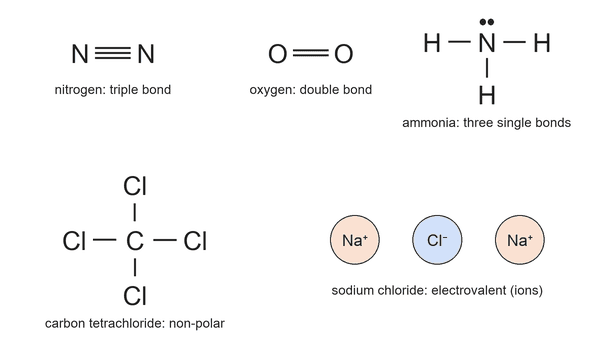
Watch out: Nitrogen and oxygen molecules are also non-polar, but their own options (triple and double bond) are more exact, and option 5 is the only one left for carbon tetrachloride.
Note: Strictly, each C–Cl bond is slightly polar (Cl 3.0, C 2.5); it is the CCl₄ molecule as a whole that is non-polar, because the four bond pulls cancel.
Therefore, (a) → 3, (b) → 5, (c) → 4, (d) → 1, (e) → 2.
- 511 mark
Question 51
Elements A, B, C & D have the following electronic configurations:
[A = 2, 8, 7 B = 1 C = 2, 5 D = 2, 8, 1]
Answer the following questions:
State the formula of the compound formed when D reacts with C.
Solve with AIWritten solution
Solution:
Concept: In an ionic compound the total positive charge equals the total negative charge, so the compound is neutral. To write its formula, take enough of each ion to make the charges cancel (criss-cross the valencies and reduce to the simplest ratio).
Step 1 — Read the valence electrons.
D (2, 8, 1) has 1 valence electron, so it is a metal that loses 1 electron. C (2, 5) has 5 valence electrons, so it is a non-metal that needs 3 more.
Step 2 — Write the two ions.
Each D atom loses one electron and each C atom gains three:
Step 3 — Balance the charges.
One ion needs three ions to make the compound neutral, because three charges of +1 cancel one charge of −3:
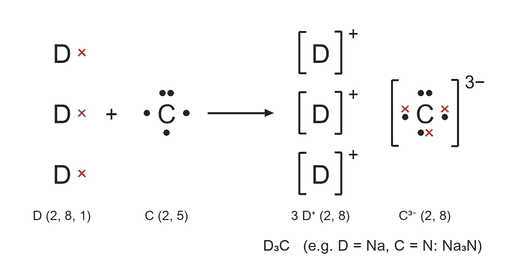
Watch out: The element whose symbol is written first is the metal D (the positive ion), so the formula is D₃C, not CD₃.
Therefore, the formula of the compound formed when D reacts with C is D₃C (an electrovalent compound; with D = sodium and C = nitrogen it would be sodium nitride, Na₃N).
- 521 mark
Question 52
Distinguish between the following:
Hydronium ion and ammonium ion based on their lone pair of electrons.
Solve with AIWritten solution
Solution:
Concept: A coordinate (dative) bond is a covalent bond in which both electrons of the shared pair come from the same atom (the donor, which has a lone pair) and are accepted by an atom or ion that is short of a pair (the acceptor, such as ). It is shown by an arrow from the donor to the acceptor. To compare the ions, count the lone pairs left on the central atom after the donation.
Step 1 — Count for the hydronium ion.
In water, oxygen has two lone pairs. It donates one of them to , so in one lone pair is left on oxygen.
Step 2 — Count for the ammonium ion.
In ammonia, nitrogen has one lone pair. It donates this pair to , so in no lone pair is left on nitrogen.
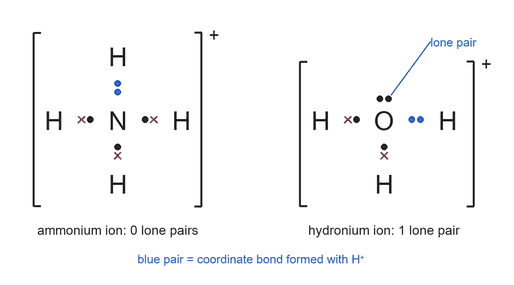
Watch out: Both ions are formed by a coordinate bond; they differ only in what is LEFT on the central atom.
Therefore, the hydronium ion has one lone pair (on oxygen), while the ammonium ion has no lone pair.