
Question 272 marksAsked 2024Easy
Give reasons for the following:
(a) Inert gases do not form ions.
(b) Covalent compounds have a low melting and boiling point.
Confirming your payment
Sign up now and get 250 free tokens.
Previous Year Questions · Question 27 of 52
Give reasons for the following:
(a) Inert gases do not form ions.
(b) Covalent compounds have a low melting and boiling point.
Solution:
Concept: Atoms of the noble gases (helium, neon, argon …) are stable and do not combine, because their outermost shell is complete: 8 electrons (an octet), or 2 electrons (a duplet) for helium. Every other atom tends to reach the electronic configuration of its nearest noble gas by losing, gaining or sharing electrons, and this is why atoms form chemical bonds. Electrovalent compounds are made of ions held by strong electrostatic forces in a crystal lattice; covalent compounds are made of molecules, and the forces between molecules are weak. Almost every difference in their properties (state, melting and boiling points, solubility, conductivity) follows from this.
Step 1 — (a) Look at the outer shell of an inert gas.
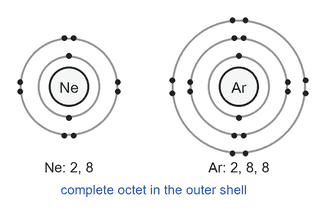
The inert (noble) gases already have a complete outermost shell: neon 2, 8, argon 2, 8, 8 (an octet), and helium 2 (a duplet).
Step 2 — (a) Explain why no ions form.
An atom forms an ion only by losing or gaining electrons to reach a stable configuration. An inert gas atom is already stable, so it has no tendency to lose or gain electrons, and therefore it does not form ions.
Step 3 — (b) Look at the particles in a covalent compound.
A covalent compound is made of separate molecules. The atoms inside each molecule are held by strong covalent bonds, but the forces of attraction between the molecules are weak.
Step 4 — (b) Explain the low melting and boiling points.
Melting and boiling only need the molecules to be separated from one another; the covalent bonds inside them are not broken. Because the forces between the molecules are weak, only a little heat energy is needed, so the compound melts and boils at low temperatures.
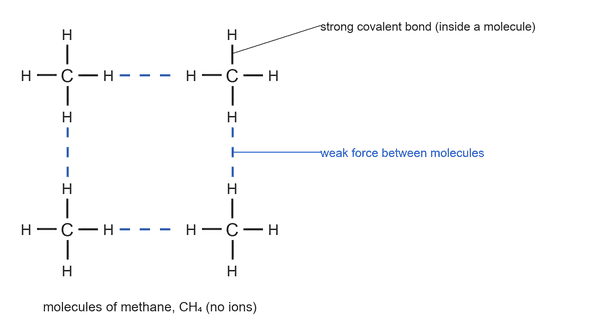
Watch out: Melting a covalent compound does NOT break its covalent bonds; it only overcomes the weak forces between the molecules.
Therefore, (a) inert gases do not form ions because they already have a stable octet (helium a duplet) and do not need to lose or gain electrons; (b) covalent compounds have low melting and boiling points because the forces between their molecules are weak.