
Question 281 markAsked 2024Easy
Fill in the blanks by choosing the correct answer from the bracket:
(a) Carbon tetrachloride is a ............... [polar / non-polar] covalent molecule.
Confirming your payment
Sign up now and get 250 free tokens.
Previous Year Questions · Question 28 of 52
Fill in the blanks by choosing the correct answer from the bracket:
(a) Carbon tetrachloride is a ............... [polar / non-polar] covalent molecule.
Solution:
Concept: Electronegativity is the tendency of an atom to attract a shared pair of electrons towards itself. If the two bonded atoms have equal electronegativity, the pair is shared equally and the bond is non-polar; if one is more electronegative, it pulls the pair closer, gets a partial negative charge (δ−) and the other a partial positive charge (δ+), and the bond is polar. A molecule with polar bonds can still be non-polar overall if the bonds are arranged symmetrically, so that their pulls cancel.
Step 1 — Look at each C–Cl bond.
Chlorine (electronegativity 3.0) attracts the shared pair a little more than carbon (2.5), so each C–Cl bond on its own is slightly polar.
Step 2 — Look at the shape of the whole molecule.
The four chlorine atoms are arranged symmetrically round the carbon atom (at the corners of a regular tetrahedron), so the four equal pulls cancel out. The molecule has no positive end and no negative end.
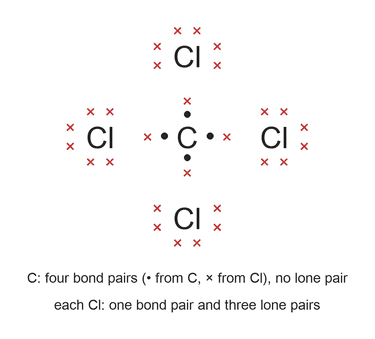
Step 3 — Fill in the blank.
With no overall partial charges, carbon tetrachloride is a non-polar covalent molecule. This is also why it does not mix with water and does not conduct electricity.
Watch out: A molecule with polar bonds is not automatically polar; check whether its shape makes the pulls cancel.
Therefore, carbon tetrachloride is a non-polar covalent molecule.