
Question 461 markMCQAsked 2026Easy
A polar covalent compound with two lone pairs of electrons is:
Confirming your payment
Sign up now and get 250 free tokens.
Previous Year Questions · Question 46 of 52
A polar covalent compound with two lone pairs of electrons is:
(A) ammonia
(B) water
(C) chlorine
(D) oxygen
Answer: (B) water
Concept: Electronegativity is the tendency of an atom to attract a shared pair of electrons towards itself. If the two bonded atoms have equal electronegativity, the pair is shared equally and the bond is non-polar; if one is more electronegative, it pulls the pair closer, gets a partial negative charge (δ−) and the other a partial positive charge (δ+), and the bond is polar. A lone pair is a pair of valence electrons not used in bonding; count them on the central atom.
Step 1 — Count the lone pairs in water.
Oxygen (2, 6) uses 2 of its 6 valence electrons in its two O–H bonds and keeps 4 unshared, which are two lone pairs.
Step 2 — Check that water is a polar covalent compound.
Water is a compound of two elements, and oxygen (3.5) pulls each shared pair away from hydrogen (2.1), so its bonds are polar covalent.
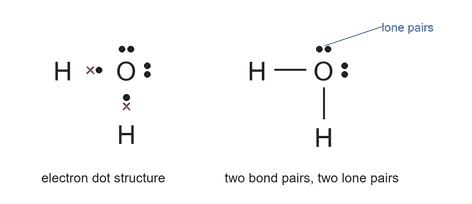
Watch out: The question asks for a COMPOUND; chlorine and oxygen are elements, so they are out whatever their lone pairs.
Why the other options are wrong:
Therefore, the polar covalent compound with two lone pairs of electrons is water, option (B).