
Question 471 markMCQAsked 2026Easy
The table below shows the atomic numbers of elements W, X, Y and Z.
| Element | Atomic Number |
|---|---|
| W | 4 |
| X | 13 |
| Y | 7 |
| Z | 10 |
Which of the above elements will combine to form an electrovalent compound?
Confirming your payment
Sign up now and get 250 free tokens.
Previous Year Questions · Question 47 of 52
The table below shows the atomic numbers of elements W, X, Y and Z.
| Element | Atomic Number |
|---|---|
| W | 4 |
| X | 13 |
| Y | 7 |
| Z | 10 |
Which of the above elements will combine to form an electrovalent compound?
(A) Y and Z
(B) C and Z
(C) X and Y
(D) X and W
Answer: (C) X and Y
Concept: An electrovalent compound forms between a metal that loses electrons and a non-metal that gains them. Write each configuration first to see which elements are metals and which are non-metals.
Step 1 — Write the configurations.
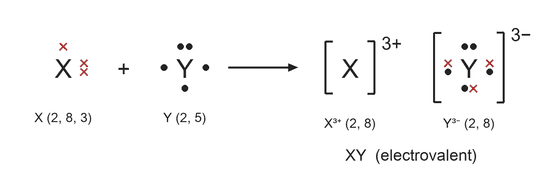
W (4) is 2, 2, a metal (2 valence electrons). X (13) is 2, 8, 3, a metal (3 valence electrons). Y (7) is 2, 5, a non-metal (5 valence electrons). Z (10) is 2, 8, a noble gas.
Step 2 — Find the metal and non-metal pair.
X loses 3 electrons and Y gains 3, so X and Y can form ions:
Both ions then have a stable octet (2, 8), and the charges 3+ and 3− cancel, so X and Y form the electrovalent compound XY.
Watch out: In this simple model a metal and a non-metal give an electrovalent compound; real aluminium nitride (X = Al, Y = N) has a lot of covalent character, but X and Y is still the only metal–non-metal pair offered.
Why the other options are wrong:
Therefore, the elements that combine to form an electrovalent compound are X and Y, option (C).