Solution:
Concept: The period number of an element is its number of shells, and for groups 13 to 18 the number of valence electrons is the group number minus 10. A non-metal atom then shares as many electrons as it needs to complete its octet.
Step 1 — (a) Identify element A.
Period 2 means the atom has two shells, and group 15 means it has 15 − 10 = 5 valence electrons. So its configuration is 2, 5, which adds up to atomic number 7: element A is nitrogen (N).
Step 2 — (b) Write the formula of the hydride.
Nitrogen has 5 valence electrons and needs 3 more for an octet; each hydrogen needs 1 more for a duplet. So one nitrogen atom shares one pair with each of three hydrogen atoms, and the formula is NH3 (ammonia), that is AH₃.
Step 3 — (c) Draw the dot and cross structure.
Nitrogen's electrons are shown as dots and hydrogen's as crosses. Each N–H bond is one dot and one cross.
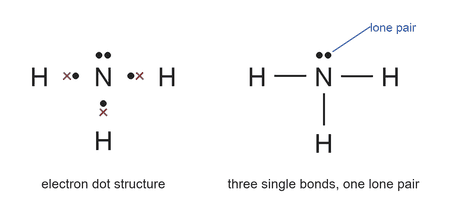
There are three single covalent N–H bonds; nitrogen gets an octet with one lone pair, and each hydrogen gets a duplet.
Watch out: Do not forget the lone pair on nitrogen; without it nitrogen shows only 6 electrons.
Therefore, (a) A is nitrogen; (b) the compound is NH₃ (ammonia); (c) NH₃ has three N–H shared pairs and one lone pair on nitrogen.
