
Question 103 marksAsked 2018Medium
(i) What do you understand by a lone pair of electrons?
(ii) Draw the electron dot diagram of Hydronium ion. (H=1; O=8)
Confirming your payment
Sign up now and get 250 free tokens.
Previous Year Questions · Question 10 of 52
(i) What do you understand by a lone pair of electrons?
(ii) Draw the electron dot diagram of Hydronium ion. (H=1; O=8)
Solution:
Concept: After bonding, an atom may still have pairs of valence electrons that are not used in any bond; these are lone pairs. A lone pair can be donated to an ion such as to form a coordinate bond.
Step 1 — (i) Define a lone pair.
A lone pair of electrons is a pair of valence electrons on an atom that is not shared with any other atom during bond formation.
Step 2 — (i) Give an example.
In ammonia, nitrogen uses 3 of its 5 valence electrons in N–H bonds, so one pair is left unshared: one lone pair. In water, oxygen uses 2 of its 6, so it has two lone pairs.

Step 3 — (ii) Start the hydronium ion from water.
In water, oxygen (2, 6) shares one pair with each of two hydrogen atoms and keeps two lone pairs. The oxygen atom donates one of these lone pairs to a hydrogen ion, which has no electron:
Step 4 — (ii) Draw and describe the hydronium ion.
The donated pair now forms a coordinate bond between O and the third H.
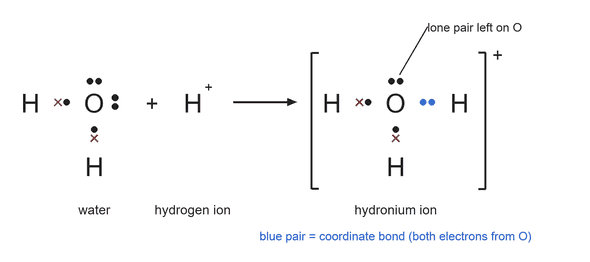
The hydronium ion has two covalent O–H bonds and one coordinate bond, one lone pair is left on oxygen, and the ion carries one positive charge (shown outside the bracket).
Watch out: After forming H₃O⁺, oxygen still has ONE lone pair (it had two and gave away one).
Therefore, (i) a lone pair is a pair of valence electrons on an atom that is not shared with any other atom; (ii) H₃O⁺ is formed when the oxygen of water donates a lone pair to H⁺, giving two covalent bonds, one coordinate bond and one lone pair on oxygen.