
Question 91 markAsked 2018Easy
Fill up the blanks with the correct choice given in brackets.
Ionic or electrovalent compounds do not conduct electricity in their ............... state. (fused / solid)
Confirming your payment
Sign up now and get 250 free tokens.
Previous Year Questions · Question 9 of 52
Fill up the blanks with the correct choice given in brackets.
Ionic or electrovalent compounds do not conduct electricity in their ............... state. (fused / solid)
Solution:
Concept: An electric current passes through a liquid or a solution only if it contains ions that are free to move. Positive ions (cations) move to the cathode (negative electrode) and negative ions (anions) move to the anode (positive electrode). An ionic compound already contains ions, but they can carry a current only if they are free to move.
Step 1 — Look at the ions in the solid.
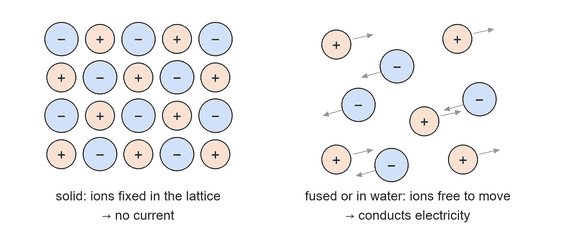
In the solid state the ions sit in fixed positions in the crystal lattice, held by strong electrostatic forces. They can vibrate but cannot move through the solid, so they cannot carry a current.
Step 2 — Look at the ions in the fused state.
When the compound is fused (melted), the lattice breaks down and the ions become free to move, so the melt conducts electricity. The same happens when the compound is dissolved in water.
Step 3 — Fill in the blank.
The compound does not conduct in the state where its ions are fixed, which is the solid state.
Watch out: An ionic solid has ions but still does not conduct; conduction needs MOBILE ions, not just ions.
Therefore, ionic or electrovalent compounds do not conduct electricity in their solid state.