
Question 84 marksAsked 2017Medium
Draw an electron dot diagram to show the formation of each of the following compounds:
(i) Methane
(ii) Magnesium Chloride
[H = 1, C = 6, Mg = 12, Cl = 17]
Confirming your payment
Sign up now and get 250 free tokens.
Previous Year Questions · Question 8 of 52
Draw an electron dot diagram to show the formation of each of the following compounds:
(i) Methane
(ii) Magnesium Chloride
[H = 1, C = 6, Mg = 12, Cl = 17]
Solution:
Concept: Methane is formed by sharing electrons (covalent bonds), and magnesium chloride by transfer of electrons (electrovalent bonds). In an electron dot diagram the dots show the electrons of one atom and the crosses those of the other, so we can see where each electron came from.
Step 1 — (i) Work out the electrons in methane.
Carbon (atomic number 6, configuration 2, 4) has 4 valence electrons and needs 4 more for an octet. Each hydrogen (atomic number 1) has 1 electron and needs 1 more for a duplet.
Step 2 — (i) Draw methane.
Carbon shares one of its electrons with each of four hydrogen atoms, so four single covalent bonds (four shared pairs) are formed.

Carbon now has 4 + 4 = 8 electrons around it (an octet), and each hydrogen has 2 (a duplet).
Step 3 — (ii) Work out the electron transfer in magnesium chloride.
Magnesium (2, 8, 2) has 2 valence electrons, and each chlorine (2, 8, 7) needs 1. So magnesium gives one electron to each of two chlorine atoms:
Step 4 — (ii) Draw magnesium chloride.
The ions formed are (2, 8) and two ions (2, 8, 8), each with a stable octet, held together by electrostatic attraction.
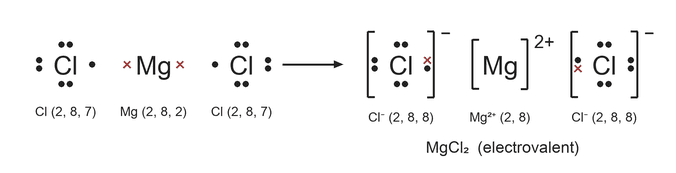
Watch out: In MgCl₂ draw TWO chloride ions, each in its own bracket with a − charge, and the magnesium ion with 2+.
Therefore, methane has four C–H single covalent bonds (C shares one electron with each of four H atoms), and magnesium chloride is Mg²⁺ with two Cl⁻ ions, formed by Mg giving one electron to each Cl atom.