
Question 72 marksAsked 2017Easy
State the type of Bonding in the following molecules:
(i) Water
(ii) Calcium oxide
Confirming your payment
Sign up now and get 250 free tokens.
Previous Year Questions · Question 7 of 52
State the type of Bonding in the following molecules:
(i) Water
(ii) Calcium oxide
Solution:
Concept: Two non-metal atoms bond by sharing electron pairs (covalent bond). A metal atom and a non-metal atom bond by transfer of electrons from the metal to the non-metal (electrovalent or ionic bond).
Step 1 — (i) Decide the bonding in water.
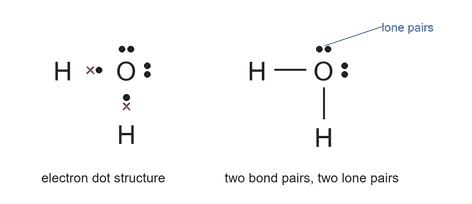
Water is made of oxygen and hydrogen, both non-metals. Oxygen (2, 6) needs 2 electrons and each hydrogen needs 1, so oxygen shares one pair with each of two hydrogen atoms: covalent bonding.
Step 2 — (i) Say what kind of covalent bond it is.
Oxygen is more electronegative than hydrogen (3.5 against 2.1 on the Pauling scale), so it pulls each shared pair towards itself. The O–H bonds are therefore polar covalent.
Step 3 — (ii) Decide the bonding in calcium oxide.
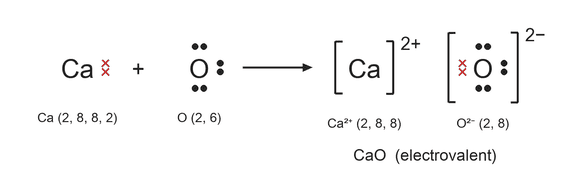
Calcium (2, 8, 8, 2) is a metal with 2 valence electrons, and oxygen (2, 6) is a non-metal that needs 2. Calcium transfers both electrons to oxygen:
The ions (2, 8, 8) and (2, 8) are held by strong electrostatic attraction: electrovalent (ionic) bonding.
Watch out: The question says 'molecules', but calcium oxide is not made of molecules at all; it is a lattice of ions.
Therefore, (i) water has covalent (polar covalent) bonding; (ii) calcium oxide has electrovalent (ionic) bonding.