Solution:
Concept: Count the shared pairs in each molecule and decide whether electrons are shared or transferred. Each option of Column 2 is used only once.
Step 1 — (a) Match ammonia.
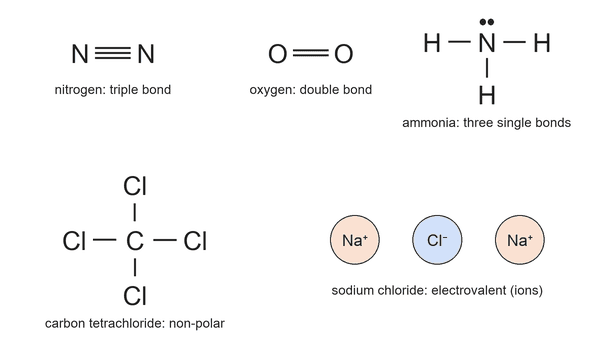
Nitrogen shares one pair with each of three hydrogen atoms, so ammonia has three single covalent bonds: (a) → 3.
Step 2 — (b) Match carbon tetrachloride.
Its four C–Cl bonds are arranged symmetrically round carbon, so the molecule is non-polar: (b) → 5, non-polar covalent bond.
Step 3 — (c) Match sodium chloride.
Sodium transfers one electron to chlorine, forming ions, so sodium chloride has an electrovalent bond: (c) → 4.
Step 4 — (d) Match nitrogen.
Two nitrogen atoms share three pairs (N≡N), a triple covalent bond: (d) → 1.
Step 5 — (e) Match oxygen.
Two oxygen atoms share two pairs (O=O), a double covalent bond: (e) → 2.
Watch out: Nitrogen and oxygen molecules are also non-polar, but their own options (triple and double bond) are more exact, and option 5 is the only one left for carbon tetrachloride.
Note: Strictly, each C–Cl bond is slightly polar (Cl 3.0, C 2.5); it is the CCl₄ molecule as a whole that is non-polar, because the four bond pulls cancel.
Therefore, (a) → 3, (b) → 5, (c) → 4, (d) → 1, (e) → 2.
