
Question 511 markAsked 2026Easy
Elements A, B, C & D have the following electronic configurations:
[A = 2, 8, 7 B = 1 C = 2, 5 D = 2, 8, 1]
Answer the following questions:
State the formula of the compound formed when D reacts with C.
Confirming your payment
Sign up now and get 250 free tokens.
Previous Year Questions · Question 51 of 52
Elements A, B, C & D have the following electronic configurations:
[A = 2, 8, 7 B = 1 C = 2, 5 D = 2, 8, 1]
Answer the following questions:
State the formula of the compound formed when D reacts with C.
Solution:
Concept: In an ionic compound the total positive charge equals the total negative charge, so the compound is neutral. To write its formula, take enough of each ion to make the charges cancel (criss-cross the valencies and reduce to the simplest ratio).
Step 1 — Read the valence electrons.
D (2, 8, 1) has 1 valence electron, so it is a metal that loses 1 electron. C (2, 5) has 5 valence electrons, so it is a non-metal that needs 3 more.
Step 2 — Write the two ions.
Each D atom loses one electron and each C atom gains three:
Step 3 — Balance the charges.
One ion needs three ions to make the compound neutral, because three charges of +1 cancel one charge of −3:
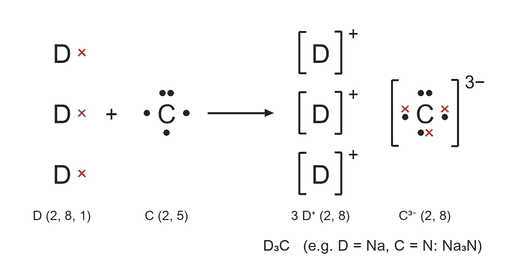
Watch out: The element whose symbol is written first is the metal D (the positive ion), so the formula is D₃C, not CD₃.
Therefore, the formula of the compound formed when D reacts with C is D₃C (an electrovalent compound; with D = sodium and C = nitrogen it would be sodium nitride, Na₃N).