
Question 521 markAsked 2026Easy
Distinguish between the following:
Hydronium ion and ammonium ion based on their lone pair of electrons.
Confirming your payment
Sign up now and get 250 free tokens.
Previous Year Questions · Question 52 of 52
Distinguish between the following:
Hydronium ion and ammonium ion based on their lone pair of electrons.
Solution:
Concept: A coordinate (dative) bond is a covalent bond in which both electrons of the shared pair come from the same atom (the donor, which has a lone pair) and are accepted by an atom or ion that is short of a pair (the acceptor, such as ). It is shown by an arrow from the donor to the acceptor. To compare the ions, count the lone pairs left on the central atom after the donation.
Step 1 — Count for the hydronium ion.
In water, oxygen has two lone pairs. It donates one of them to , so in one lone pair is left on oxygen.
Step 2 — Count for the ammonium ion.
In ammonia, nitrogen has one lone pair. It donates this pair to , so in no lone pair is left on nitrogen.
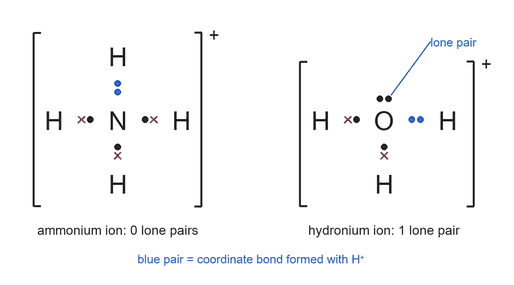
Watch out: Both ions are formed by a coordinate bond; they differ only in what is LEFT on the central atom.
Therefore, the hydronium ion has one lone pair (on oxygen), while the ammonium ion has no lone pair.