
Question 21 markMCQAsked 2016Easy
An element with the atomic number 19 will most likely combine chemically with the element whose atomic number is:
Confirming your payment
Sign up now and get 250 free tokens.
Previous Year Questions · Question 2 of 52
An element with the atomic number 19 will most likely combine chemically with the element whose atomic number is:
(A) 17
(B) 11
(C) 18
(D) 20
Answer: (A) 17
Concept: An atom with one valence electron loses it easily to reach a stable octet, so it combines with an atom that needs exactly one more electron to complete its octet. The bond formed by this transfer is electrovalent.
Step 1 — Identify the element with atomic number 19.
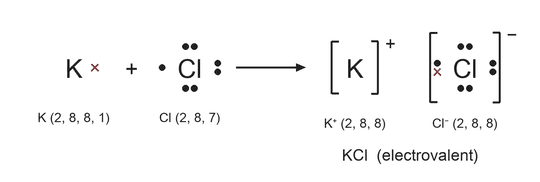
We write its configuration by filling the shells 2, 8, 8 … in turn. Atomic number 19 is potassium, configuration 2, 8, 8, 1, so it has 1 valence electron, which it loses to form .
Step 2 — Look for an atom that needs one electron.
Atomic number 17 is chlorine, configuration 2, 8, 7. It has 7 valence electrons and needs just one more to complete its octet, so it accepts potassium's electron.
Step 3 — Name the compound.
The electron moves from K to Cl; the ions (2, 8, 8) and (2, 8, 8) attract each other and form potassium chloride, KCl, an electrovalent compound.
Watch out: Atomic number 18 or 20 is next to 19 in number, but closeness in atomic number says nothing about bonding; look at the valence electrons.
Why the other options are wrong:
Therefore, the element with atomic number 19 (potassium) combines with atomic number 17 (chlorine), option (A).