
Question 401 markMCQAsked 2026Easy
Which of the following element pairs will form an ionic bond?
| Pair | |
|---|---|
| P | Elements of Group 1 & Group 2 |
| Q | Elements of Group 14 & Group 16 |
| R | Elements of Group 2 & Group 17 |
| S | Elements of Group 15 & Group 18 |
Confirming your payment
Sign up now and get 250 free tokens.
Previous Year Questions · Question 40 of 52
Which of the following element pairs will form an ionic bond?
| Pair | |
|---|---|
| P | Elements of Group 1 & Group 2 |
| Q | Elements of Group 14 & Group 16 |
| R | Elements of Group 2 & Group 17 |
| S | Elements of Group 15 & Group 18 |
(A) P
(B) Q
(C) R
(D) S
Answer: (C) R
Concept: An ionic bond forms between a metal that loses electrons easily and a non-metal that gains them. Groups 1 and 2 are metals (except hydrogen), groups 16 and 17 are reactive non-metals, and group 18 is the noble gases.
Step 1 — Look at group 2.
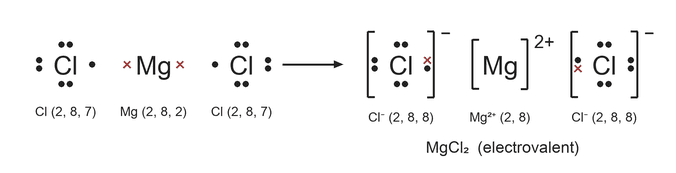
Group 2 elements, such as magnesium (2, 8, 2), have 2 valence electrons and are metals that lose them easily.
Step 2 — Look at group 17.
Group 17 elements, such as chlorine (2, 8, 7), have 7 valence electrons and are non-metals that gain 1 electron easily.
Step 3 — Combine them.
One group 2 atom gives one electron to each of two group 17 atoms, forming an ionic compound such as magnesium chloride, . So pair R forms an ionic bond.
Watch out: An ionic bond needs one partner that LOSES and one that GAINS electrons; two metals or two non-metals cannot form one.
Why the other options are wrong:
Therefore, the pair that forms an ionic bond is R (group 2 with group 17), option (C).