
Question 393 marksAsked 2025Medium
Draw the dot and cross structure of the following:
(a) Hydronium ion
(b) Oxygen molecule
(c) Calcium oxide
[Atomic number: H = 1, O = 8, Ca = 20]
Confirming your payment
Sign up now and get 250 free tokens.
Previous Year Questions · Question 39 of 52
Draw the dot and cross structure of the following:
(a) Hydronium ion
(b) Oxygen molecule
(c) Calcium oxide
[Atomic number: H = 1, O = 8, Ca = 20]
Solution:
Concept: The hydronium ion forms when a lone pair of water is donated to (a coordinate bond); the oxygen molecule forms when two oxygen atoms share two pairs (a double covalent bond); calcium oxide forms by the transfer of two electrons (an electrovalent bond). Dots (•) show the electrons of one atom and crosses (×) those of the other.
Step 1 — (a) Form the hydronium ion.
In water, oxygen keeps two lone pairs. It donates one of them to a hydrogen ion:
Step 2 — (a) Draw the hydronium ion.
The donated pair (blue) is the coordinate bond.
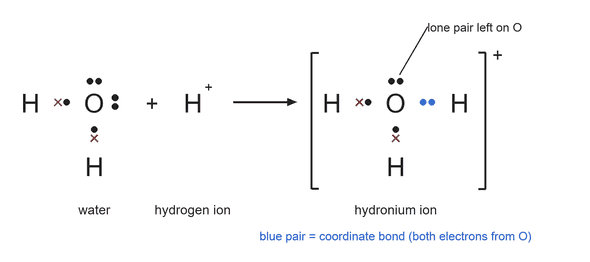
The ion has two covalent O–H bonds and one coordinate bond, one lone pair is left on oxygen, and the ion has a single + charge.
Step 3 — (b) Draw the oxygen molecule.
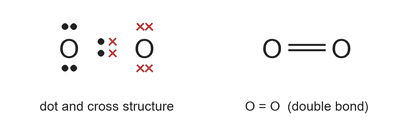
Each oxygen atom (2, 6) needs 2 electrons, so each puts 2 electrons into the bond and the atoms share two pairs: a double covalent bond (O=O). Each atom keeps two lone pairs, so each has 4 shared + 4 unshared = 8 electrons.
Step 4 — (c) Draw calcium oxide.
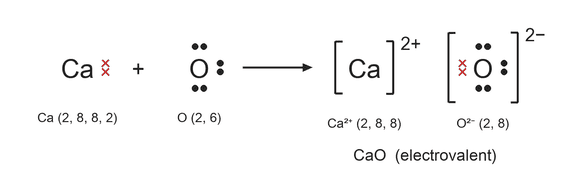
Calcium (2, 8, 8, 2) transfers its two valence electrons to oxygen:
This gives (2, 8, 8) and (2, 8), held by electrostatic attraction.
Watch out: O₂ has a DOUBLE bond (two shared pairs); drawing a single shared pair leaves each oxygen with only 7 electrons.
Therefore, (a) H₃O⁺: two covalent O–H bonds, one coordinate bond and one lone pair on O; (b) O₂: two shared pairs (O=O) and two lone pairs on each O; (c) CaO: Ca²⁺ and O²⁻ formed by the transfer of two electrons.