
Question 151 markAsked 2020Easy
Fill in the blanks from the choices given in brackets:
(i) The polar covalent compound in gaseous state that does not conduct electricity is ...............
(carbon tetra chloride, ammonia, methane)
Confirming your payment
Sign up now and get 250 free tokens.
Previous Year Questions · Question 15 of 52
Fill in the blanks from the choices given in brackets:
(i) The polar covalent compound in gaseous state that does not conduct electricity is ...............
(carbon tetra chloride, ammonia, methane)
Solution:
Concept: Electronegativity is the tendency of an atom to attract a shared pair of electrons towards itself. If the two bonded atoms have equal electronegativity, the pair is shared equally and the bond is non-polar; if one is more electronegative, it pulls the pair closer, gets a partial negative charge (δ−) and the other a partial positive charge (δ+), and the bond is polar. A substance conducts only if it contains free ions (or free electrons).
Step 1 — Sort the three choices by polarity.
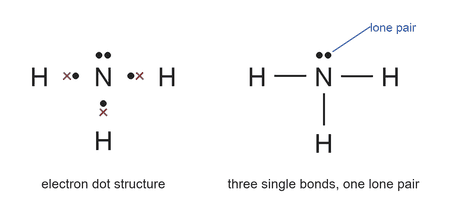
In ammonia, nitrogen (electronegativity 3.0) pulls the shared pairs more than hydrogen (2.1) does, and the molecule is not symmetrical, so ammonia is polar. Methane and carbon tetrachloride are symmetrical, so they are non-polar molecules.
Step 2 — Check the state.
Ammonia and methane are gases at room temperature, but carbon tetrachloride is a liquid.
Step 3 — Check the conduction.
Dry ammonia gas is made only of neutral molecules with no free ions, so it does not conduct electricity. It is the only choice that is polar covalent and a gas.
Watch out: Ammonia SOLUTION (in water) conducts weakly because it forms NH₄⁺ and OH⁻ ions; the blank is about the dry gas.
Therefore, the polar covalent compound in gaseous state that does not conduct electricity is ammonia.