Solution:
Concept: Calcium oxide forms by transfer of electrons (electrovalent bond); the chlorine and water molecules form by sharing pairs of electrons (covalent bonds). Dots (.) show the electrons of one atom and crosses (x) those of the other.
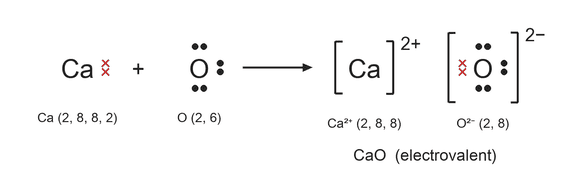
Step 1 — (i) Work out the transfer in calcium oxide.
Calcium (2, 8, 8, 2) has 2 valence electrons and oxygen (2, 6) needs 2, so calcium transfers both its valence electrons to oxygen:
Ca→Ca2++2e−
O+2e−→O2−
Step 2 — (i) Draw calcium oxide.
The ions Ca2+ (2, 8, 8) and O2− (2, 8) are held by electrostatic attraction: an electrovalent compound.
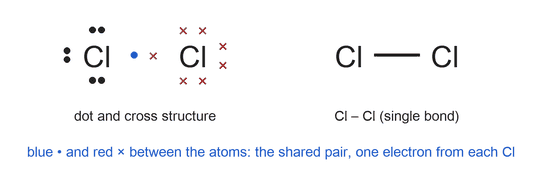
Step 3 — (ii) Draw the chlorine molecule.
Each chlorine atom (2, 8, 7) needs one electron. The two atoms share one pair, one electron from each, which is a single covalent bond, and each atom keeps three lone pairs.
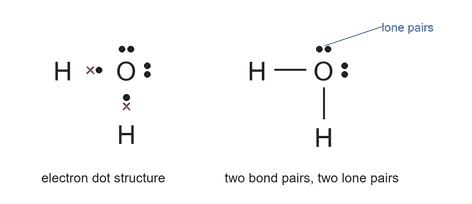
Step 4 — (iii) Draw the water molecule.
Oxygen (2, 6) shares one pair with each of two hydrogen atoms. Oxygen gets an octet with two lone pairs, and each hydrogen gets a duplet.
Watch out: In CaO the oxygen ion gets the two crosses from calcium inside its bracket; nothing is 'shared' in an ionic compound.
Therefore, (i) CaO is Ca²⁺ and O²⁻ formed by the transfer of two electrons; (ii) Cl₂ has one shared pair and three lone pairs on each Cl; (iii) H₂O has two O–H shared pairs and two lone pairs on oxygen.
