
Question 171 markAsked 2020Easy
Differentiate between the following pairs based on the information given in the brackets.
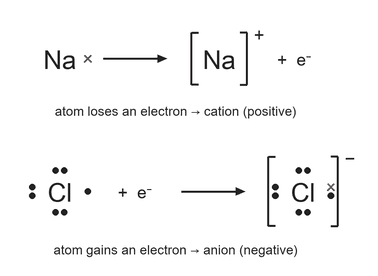
(ii) Cations and anions (formation from an atom)
Confirming your payment
Sign up now and get 250 free tokens.
Previous Year Questions · Question 17 of 52
Differentiate between the following pairs based on the information given in the brackets.
(ii) Cations and anions (formation from an atom)
Solution:
Concept: An ion is formed when an atom loses or gains electrons to reach a stable (noble gas) configuration. The number of protons does not change, so the charge on the ion comes from the electrons lost or gained.
Step 1 — Describe how a cation forms.
A cation is formed when an atom loses one or more electrons. It is left with more protons than electrons, so it carries a positive charge. Metal atoms usually form cations.
Step 2 — Describe how an anion forms.
An anion is formed when an atom gains one or more electrons. It then has more electrons than protons, so it carries a negative charge. Non-metal atoms usually form anions.
Watch out: Losing a negative electron makes the particle POSITIVE; it is easy to get this the wrong way round.
Therefore, a cation is formed when an atom loses electrons (positive ion), while an anion is formed when an atom gains electrons (negative ion).