
Question 123 marksAsked 2019Medium
Draw the electron dot structure of:
(i) Nitrogen molecule [N = 7]
(ii) Sodium chloride [Na = 11, Cl = 17]
(iii) Ammonium ion [N = 7, H = 1]
Confirming your payment
Sign up now and get 250 free tokens.
Previous Year Questions · Question 12 of 52
Draw the electron dot structure of:
(i) Nitrogen molecule [N = 7]
(ii) Sodium chloride [Na = 11, Cl = 17]
(iii) Ammonium ion [N = 7, H = 1]
Solution:
Concept: The nitrogen molecule forms by sharing (covalent bonds); sodium chloride by transfer of an electron (electrovalent bond); the ammonium ion by a lone pair being donated to (coordinate bond). Dots and crosses show which atom each electron came from.
Step 1 — (i) Work out the sharing in the nitrogen molecule.
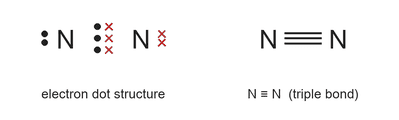
Each nitrogen atom (2, 5) has 5 valence electrons and needs 3 more for an octet. So each atom puts 3 electrons into the bond and the two atoms share three pairs: a triple covalent bond, N≡N.
Step 2 — (i) Draw the nitrogen molecule.
Each nitrogen keeps its remaining two electrons as one lone pair, so each atom has 6 shared + 2 = 8 electrons.
Step 3 — (ii) Work out the transfer in sodium chloride.
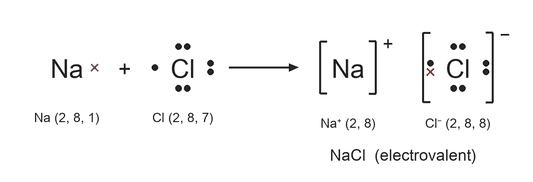
Sodium (2, 8, 1) gives its one valence electron to chlorine (2, 8, 7):
Step 4 — (ii) Draw sodium chloride.
The ions (2, 8) and (2, 8, 8) both have a stable octet and are held by electrostatic attraction.
Step 5 — (iii) Draw the ammonium ion.
The lone pair on the nitrogen of ammonia is donated to a hydrogen ion:
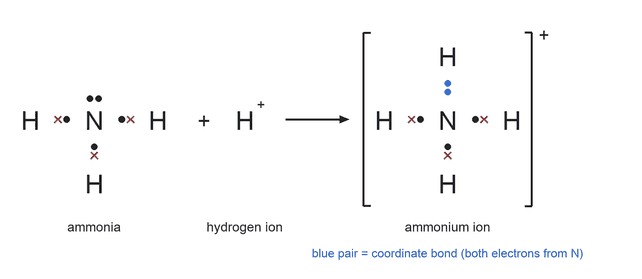
The ion has three covalent N–H bonds and one coordinate bond (blue pair, both electrons from N), no lone pair on nitrogen, and a single positive charge.
Watch out: N₂ needs THREE shared pairs and a lone pair on each N; drawing only one or two shared pairs leaves nitrogen without an octet.
Therefore, (i) N₂ has a triple covalent bond with one lone pair on each N; (ii) NaCl is Na⁺ and Cl⁻ formed by the transfer of one electron; (iii) NH₄⁺ has three covalent N–H bonds and one coordinate bond.