
Question 131 markMCQAsked 2020Easy
A compound with low boiling point, is:
Confirming your payment
Sign up now and get 250 free tokens.
Previous Year Questions · Question 13 of 52
A compound with low boiling point, is:
(A) Sodium chloride
(B) Calcium chloride
(C) Potassium chloride
(D) Carbon tetrachloride
Answer: (D) Carbon tetrachloride
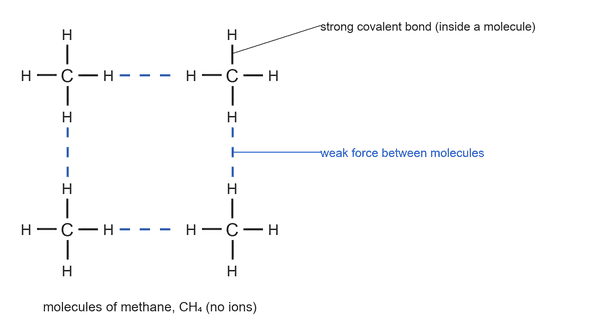
Concept: Electrovalent compounds are made of ions held by strong electrostatic forces in a crystal lattice; covalent compounds are made of molecules, and the forces between molecules are weak. Almost every difference in their properties (state, melting and boiling points, solubility, conductivity) follows from this. So covalent compounds have low melting and boiling points, and electrovalent compounds high ones.
Step 1 — Classify the three metal chlorides.
Sodium chloride, calcium chloride and potassium chloride are each formed from a metal and chlorine by the transfer of electrons, so they are electrovalent: lattices of ions held by strong forces.
Step 2 — Classify carbon tetrachloride.
Carbon tetrachloride, , is formed from two non-metals by sharing electrons, so it is a covalent compound made of molecules with only weak forces between them.
Step 3 — Compare the boiling points.
Little energy is needed to separate the molecules of CCl₄, so it is a liquid that boils at about 77 °C, while the three chlorides boil only well above 1000 °C.
Watch out: All four compounds contain chlorine; it is the OTHER element (metal or non-metal) that decides the bond type.
Why the other options are wrong:
Therefore, the compound with a low boiling point is carbon tetrachloride, option (D).