
Question 221 markAsked 2023Easy
Give reason for the following:
(b) Ionic compounds do not conduct electricity in solid state.
Confirming your payment
Sign up now and get 250 free tokens.
Previous Year Questions · Question 22 of 52
Give reason for the following:
(b) Ionic compounds do not conduct electricity in solid state.
Solution:
Concept: An electric current passes through a liquid or a solution only if it contains ions that are free to move. Positive ions (cations) move to the cathode (negative electrode) and negative ions (anions) move to the anode (positive electrode).
Step 1 — Describe the solid.
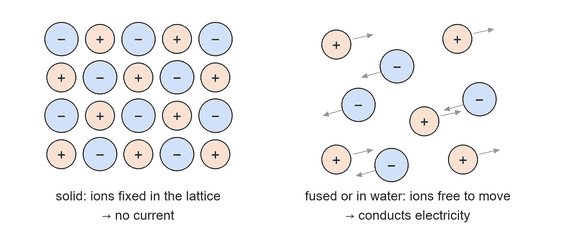
In the solid state, the ions of an ionic compound are held in fixed positions in the crystal lattice by strong electrostatic forces of attraction. They can only vibrate about these positions.
Step 2 — Link this to conduction.
A current can flow only if charged particles move towards the electrodes. The ions in the solid cannot move, and there are no free electrons, so no current flows.
Step 3 — Compare with the molten state or a solution.
When the compound is melted or dissolved in water, the lattice breaks down and the ions become free to move, so the compound then conducts.
Watch out: The solid DOES contain ions; the reason it does not conduct is that they cannot move.
Therefore, ionic compounds do not conduct electricity in the solid state because their ions are held in fixed positions in the lattice and are not free to move.