
Question 351 markMCQAsked 2025Easy
An element X has an electronic configuration 2, 2. The compound formed when X combines with oxygen is most likely to be:
Confirming your payment
Sign up now and get 250 free tokens.
Previous Year Questions · Question 35 of 52
An element X has an electronic configuration 2, 2. The compound formed when X combines with oxygen is most likely to be:
(A) a compound with a low melting point.
(B) a gas that dissolves in water to form an electrolyte.
(C) a good conductor in both solid and molten state.
(D) an ionic solid.
Answer: (D) an ionic solid.
Concept: An atom with 1, 2 or 3 valence electrons is a metal; it gives these electrons to a non-metal such as oxygen. The ions formed are held in a crystal lattice by strong electrostatic forces, so the compound is an ionic solid with a high melting point that conducts only when molten or dissolved.
Step 1 — Identify X.
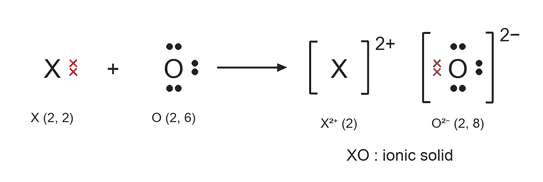
X has the configuration 2, 2, so its atomic number is 4 (beryllium, group 2). It has 2 valence electrons and loses them to form (configuration 2).
Step 2 — See what oxygen does.
Oxygen (2, 6) gains the 2 electrons to form (2, 8).
Step 3 — Describe the compound.
The ions are held in a crystal lattice by strong electrostatic forces, so the oxide XO is an ionic solid with a high melting point.
Watch out: Real beryllium oxide has some covalent character, but it is still a hard solid with a very high melting point that does not conduct when solid; of the four options only (D) describes it.
Why the other options are wrong:
Therefore, the oxide of X is most likely an ionic solid, option (D).