
Question 42 marksAsked 2016Medium
By drawing an electron dot diagram show the formation of ammonium ion [N = 7, H = 1]
Confirming your payment
Sign up now and get 250 free tokens.
Previous Year Questions · Question 4 of 52
By drawing an electron dot diagram show the formation of ammonium ion [N = 7, H = 1]
Solution:
Concept: A coordinate (dative) bond is a covalent bond in which both electrons of the shared pair come from the same atom (the donor, which has a lone pair) and are accepted by an atom or ion that is short of a pair (the acceptor, such as ). It is shown by an arrow from the donor to the acceptor.
Step 1 — Draw ammonia first.
Nitrogen (atomic number 7, configuration 2, 5) has 5 valence electrons. It shares one electron with each of three hydrogen atoms, forming three single covalent N–H bonds. This uses 3 of its 5 electrons, so one pair (2 electrons) is left unshared: the lone pair.
Step 2 — Look at the hydrogen ion.
A hydrogen ion, , is a hydrogen atom that has lost its only electron. It has an empty shell and needs a pair of electrons to get a stable duplet.
Step 3 — Form the ammonium ion.
The nitrogen atom donates its lone pair to the hydrogen ion, and the pair is now shared between N and the fourth H. Both electrons of this bond come from nitrogen, so it is a coordinate bond.
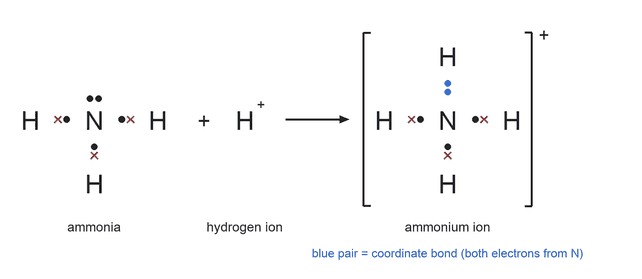
In the diagram the dots are nitrogen's electrons and the crosses are hydrogen's; the blue pair is the donated lone pair (coordinate bond).
Step 4 — Describe the ion formed.
The ammonium ion has three covalent N–H bonds and one coordinate N→H bond, no lone pair on nitrogen, and one positive charge, which it got from the ion. Once it is formed, all four N–H bonds are exactly alike.
Watch out: The positive charge belongs to the whole ion, so draw a square bracket round the structure with + outside it.
Therefore, NH₃ + H⁺ → NH₄⁺: the lone pair of nitrogen in ammonia is donated to H⁺, giving the ammonium ion with three covalent bonds and one coordinate bond.