
Question 51 markAsked 2017Easy
Fill in the blanks from the choices given in brackets:
The compound that does not have a lone pair of electrons is .............. (water, ammonia, carbon tetra chloride)
Confirming your payment
Sign up now and get 250 free tokens.
Previous Year Questions · Question 5 of 52
Fill in the blanks from the choices given in brackets:
The compound that does not have a lone pair of electrons is .............. (water, ammonia, carbon tetra chloride)
Solution:
Concept: A lone pair is a pair of valence electrons on an atom that is not shared with any other atom. To find lone pairs on the central atom, subtract the electrons it uses in bonds from its valence electrons.
Step 1 — Count for water.
Oxygen has 6 valence electrons and uses 2 of them in its two O–H bonds, so 4 electrons, that is two lone pairs, are left on oxygen.
Step 2 — Count for ammonia.
Nitrogen has 5 valence electrons and uses 3 in its three N–H bonds, so 2 electrons, that is one lone pair, are left on nitrogen.
Step 3 — Count for carbon tetrachloride.
Carbon (configuration 2, 4) has 4 valence electrons and uses all 4 in its four C–Cl bonds, so no lone pair is left on carbon.
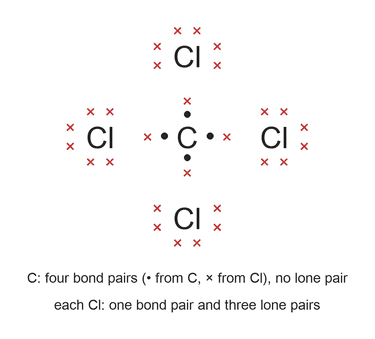
Step 4 — Fill in the blank.
Of the three compounds, only carbon tetrachloride has no lone pair on its central atom.
Watch out: Each chlorine atom in CCl₄ still carries three lone pairs (see the figure); the question is about the central carbon atom, which has none.
Therefore, the compound that does not have a lone pair of electrons is carbon tetrachloride.